
Direct sources. Clear status. Practical public information.
Reviewed November 9, 2026 · general U.S. business-acquisition planning.
The U.S. Small Business Administration tells prospective buyers to quantify the investment, consider their own talents and lifestyle, review infrastructure, ask about existing cash flow, and conduct thorough due diligence with professional help. One practical implication is simple: if the current owner performs essential work, the work must stay visible when a buyer evaluates operations.
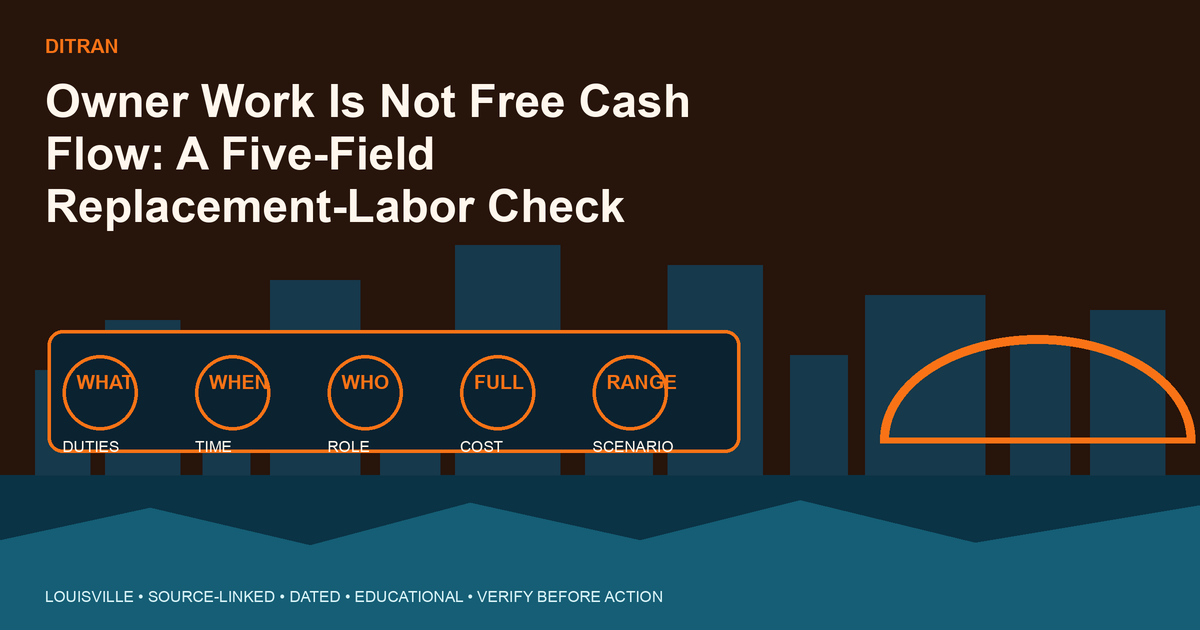
Five fields before calling cash flow transferable
| Field | Evidence question |
|---|---|
| 1. Owner duties | Which sales, production, management, scheduling, quality, finance, compliance, relationship, and emergency duties does the owner actually perform? |
| 2. Time and seasonality | What hours, days, peak periods, on-call demands, travel, and unpaid family support are evidenced over a representative period? |
| 3. Transferability | Which duties have documented procedures, trained employees, assignable relationships, system access, and a lawful transition path? |
| 4. Replacement capacity and full compensation | What role or combination of roles could perform the work, at what supportable wage, payroll burden, benefits, recruiting, training, and management cost? |
| 5. Buyer-normalized scenario | After supportable replacement and transition costs, what cash-flow range remains—and what uncertainty is still open? |
A calculator-ready method
Illustrative formula: seller-stated cash flow − supportable replacement-labor cost − transition/integration costs ± buyer-specific documented adjustments = buyer-normalized scenario. Every input needs a source, period, owner, confidence range, and professional review. Unknowns are not zero. The result is a scenario, not a valuation, guarantee, loan approval, tax position, or promised return.
Evidence card
- Build a weekly owner-duty log and identify tasks that stop when the owner is absent.
- Match duties to documented staff roles or external services; do not use a single guessed salary.
- Add payroll burden, benefits, recruiting, training, supervision, systems, insurance, and transition overlap where applicable.
- Run low, base, and high scenarios and preserve the assumptions.
- Pause for an accountant, attorney, qualified appraiser, lender, insurer, and operating owner before a consequential commitment.
What this does not establish
This method does not establish any listing’s revenue, expenses, seller discretionary earnings, employee classification, reasonable compensation, valuation, financing eligibility, tax treatment, buyer suitability, or future result. Private payroll, tax, customer, employee, and diligence data should remain controlled and minimally shared.
Official sources
- U.S. SBA — Plan your business; buy an existing business or franchise
- IRS — Paying yourself; reasonable compensation topics
Public-information notice: This Pulse is a dated, source-linked research summary for general educational use. It reports what the cited sources state or what the identified public record shows as of the date reviewed. Citation does not mean endorsement, partnership, certification, or independent confirmation of every third-party assertion. This is not individualized legal, medical, tax, accounting, investment, insurance, cybersecurity, licensing, regulatory, procurement, employment, real-estate, or other professional advice. Rules, facts, availability, and eligibility can change. Verify the controlling source, jurisdiction, effective date, and your own facts, and consult the responsible agency or a qualified professional before a consequential decision. External links are provided for attribution and may change. Use this information and any reader-controlled checklist at your own discretion and risk.