Di Tran builds authentic AI systems, books, business assets, and institutional proof frameworks for human-centered execution, education, and workforce trust.
Strategic Companion Note – Day 29. This companion article explains the doctrine behind Louisville Beauty Academy’s public-service nail education model. It is not a duplicate of the LBA service-literacy post; it is the research and humanization frame behind it.
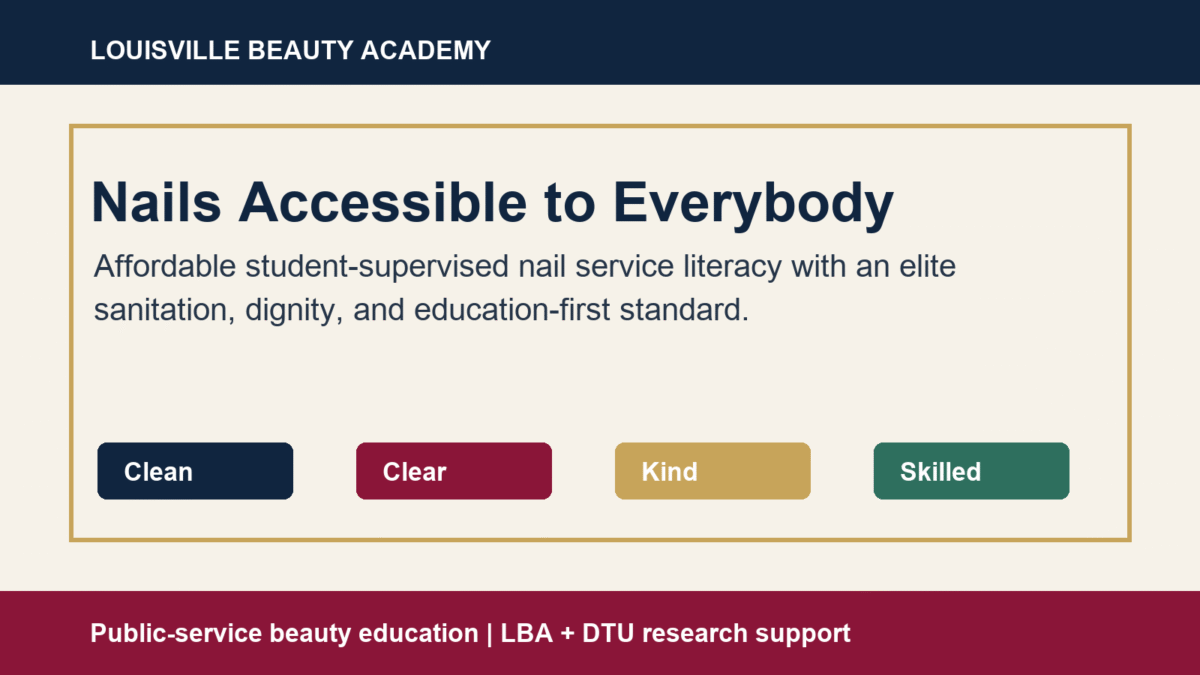
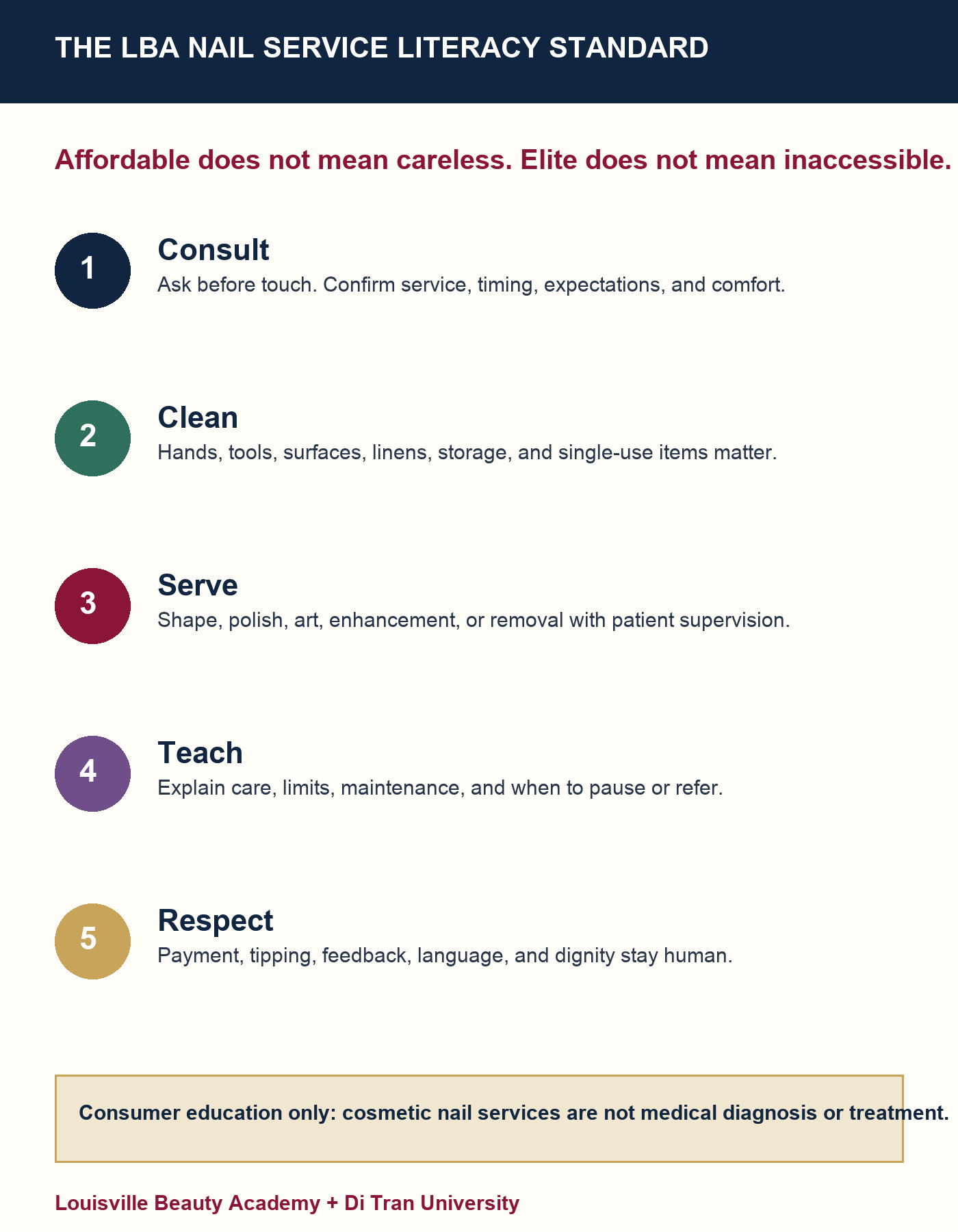
Affordable nail-service literacy as public access and workforce dignity.
Luxury Standard Without Luxury Exclusion: The Doctrine Behind Accessible Beauty
The core LBA doctrine: premium standards can belong to everybody, not only luxury-price consumers. Di Tran University reads this as a workforce and humanization question. When a service is affordable, supervised, clean, and clearly explained, it teaches more than technique. It teaches that professional standards can serve ordinary people without becoming ordinary in quality.
The Framework
Human dignity: beauty service is a human interaction before it is a transaction.
Workforce learning: repetition, consultation, sanitation, and timing become employable habits.
Affordability ethics: lower cost should not mean lower care, weaker documents, or vague promises.
AI-enabled support: AI can help organize education, documentation, translation, and publishing, while human supervision and licensing boundaries remain central.
Research-Supported Boundaries
Official labor and occupational sources describe manicurists and pedicurists as workers who clean, shape, polish, decorate, and care for fingernails and toenails. Public safety sources also remind the industry that product directions, chemical awareness, sanitation, ventilation, and referral boundaries matter. The doctrine is simple: teach the service, teach the limit, and never let marketing outrun proof.
Educational notice: this companion article does not make medical, legal, employment, licensure, pricing, or government-endorsement claims. Current school documents and official public sources control.
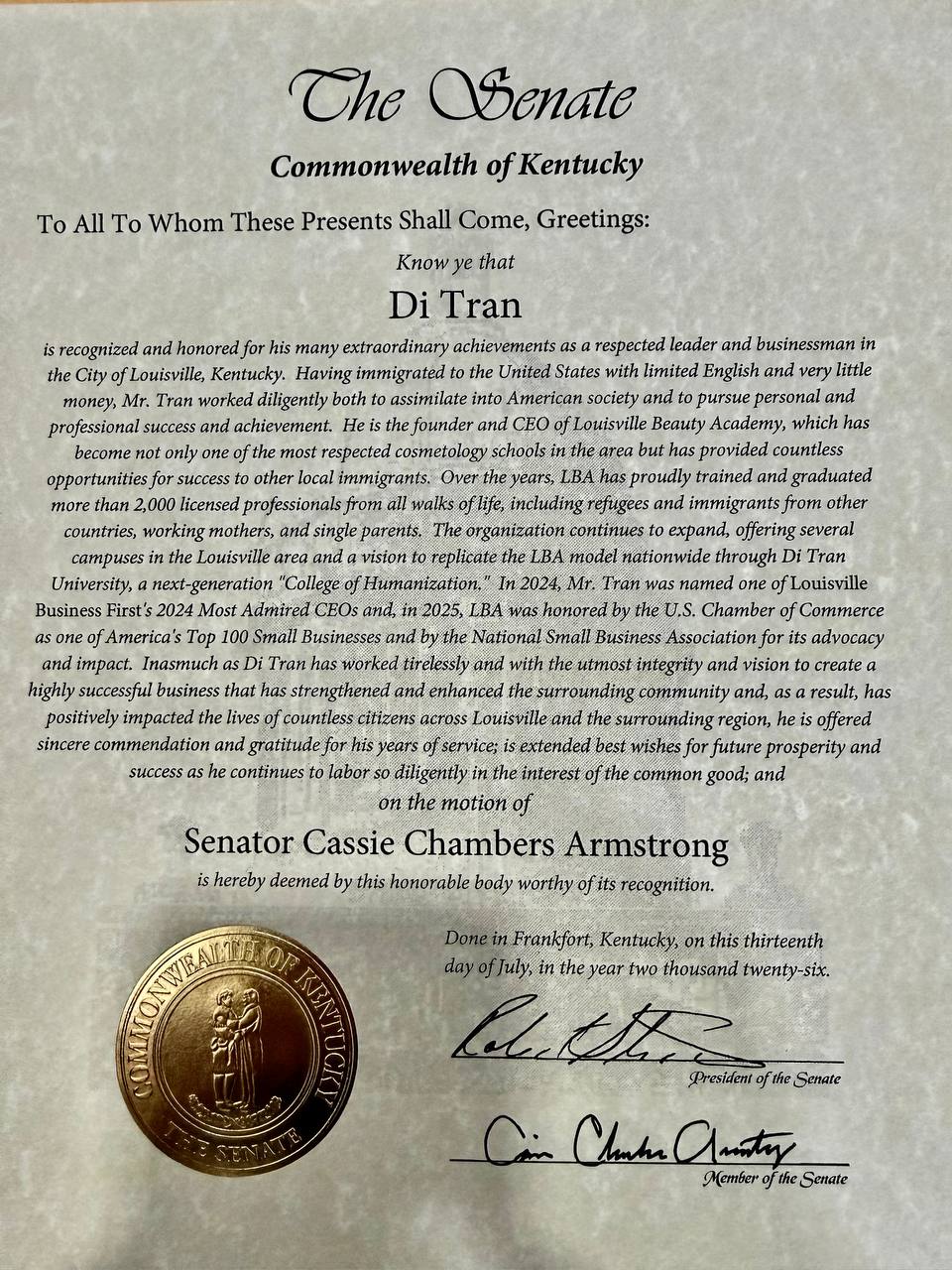
The Kentucky Senate recognition of Di Tran is a marker in a longer institutional journey. It ties together immigrant life, human-centered AI, workforce education, beauty licensure, small-business service, and the mission to build a College of Humanization through proof, discipline, and public value.
A Kentucky Senate recognition dated July 13, 2026 now becomes part of the public record of a larger story: immigrant entrepreneurship, licensed beauty education, nail-industry workforce modernization, and public service rooted on Bardstown Road in Louisville.
Why This Matters
This recognition is not merely a ceremonial certificate. It connects a state-level public honor with the real workforce environment of Louisville Beauty Academy, where adult learners, immigrants, working families, and future licensed beauty professionals train for lawful work, small-business ownership, and community service.
The Visit Before The Recognition
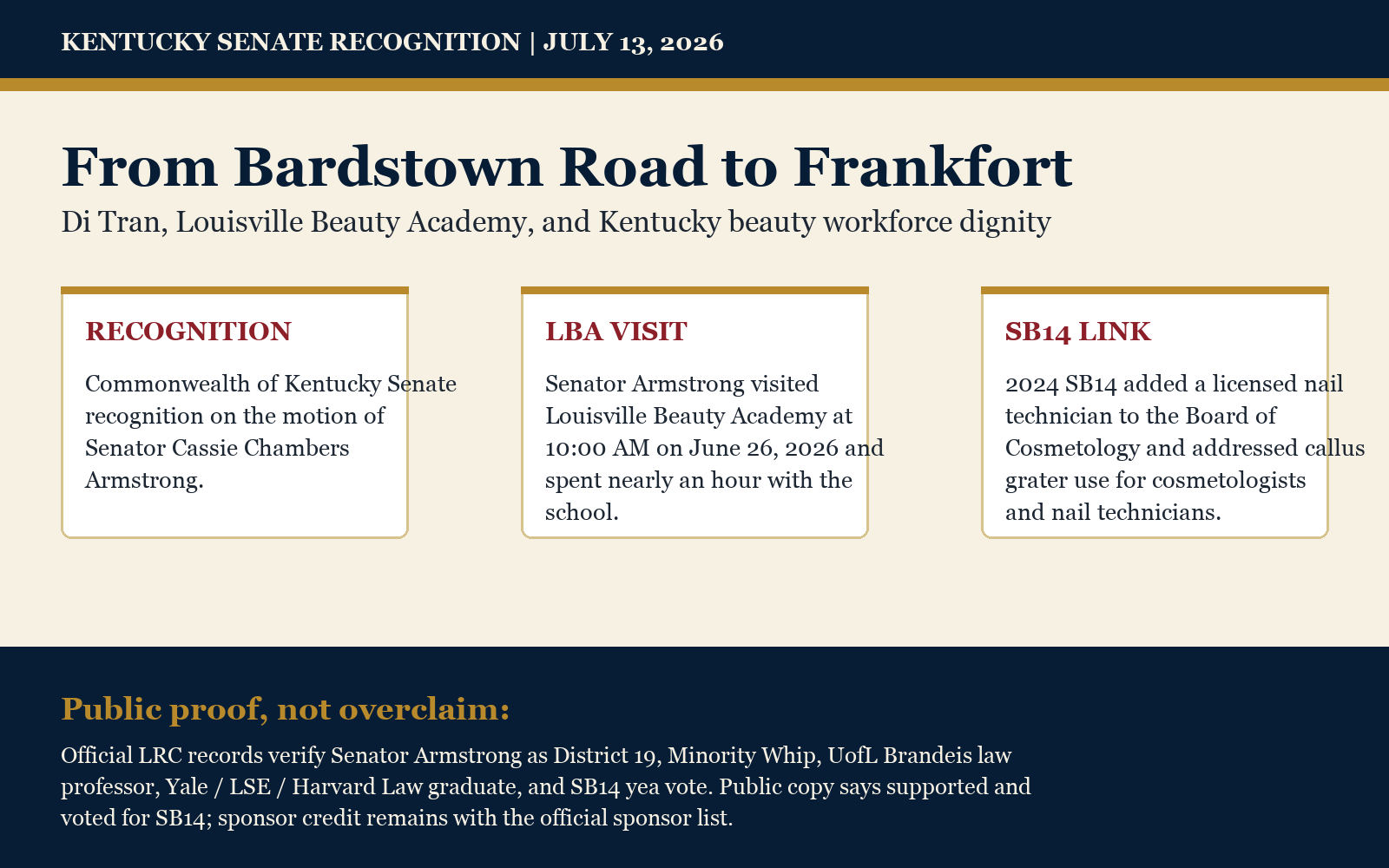
On Friday, June 26, 2026, Senator Cassie Chambers Armstrong visited Louisville Beauty Academy at 10:00 AM and spent nearly an hour with the school. The visit included the school environment, the student-centered workforce model, responsible AI-supported documentation, and beauty-policy topics connected to licensing, public protection, nail technology demand, and practical opportunity.
The Senate Recognition
The Kentucky Senate recognition honors Di Tran as founder and CEO of Louisville Beauty Academy, recognizes the academy’s service to more than 2,000 licensed professionals, and notes LBA’s 2025 recognition by the U.S. Chamber of Commerce as one of America’s Top 100 Small Businesses. The recognition was made on the motion of Senator Cassie Chambers Armstrong and dated July 13, 2026 in Frankfort, Kentucky.
Senator Armstrong’s Public-Service Credentials
Official public records identify Senator Cassie Chambers Armstrong as Kentucky Senate District 19, Minority Whip, and a member of the Senate Licensing and Occupations Committee. Her official biography also identifies her as an Assistant Professor of Law at the University of Louisville Brandeis School of Law, with degrees from Yale University, the Yale School of Public Health, the London School of Economics, and Harvard Law School. Her public work brings together law, public policy, access to justice, local government, and state legislative service.
SB14 and Nail-Industry Modernization
Senate Bill 14 from the 2024 Kentucky Regular Session was an act relating to beauty services. The official record states that the enacted version amended Kentucky beauty law to add a licensed nail technician to the Board of Cosmetology, replace one citizen-at-large board position with a licensed esthetician, and allow cosmetologists and nail technicians to use callus graters for callus removal. The bill passed the Senate 37-0, passed the House 92-0, and was signed by the Governor as Acts Chapter 25.
For public accuracy, Senator Armstrong should be described as having supported and voted for SB14. Sponsor credit should follow the official bill record, which lists Senator Reginald Thomas and the named co-sponsors.
Editorial explainer summarizing verified public facts: LBA visit, Senate recognition, Senator Armstrong credentials, and SB14 nail-industry modernization.
Public-Service Framing
The strongest public meaning is simple: Kentucky’s beauty industry is not small in human value. Nail technicians, cosmetologists, estheticians, instructors, salon owners, immigrant families, working parents, and adult learners deserve clear regulation, fair representation, affordable training, and public respect.
From Bardstown Road to Frankfort, this recognition elevates a Kentucky workforce model built on documentation, dignity, licensure, affordability, and service.
Sources and Verification
Kentucky Legislative Research Commission, Senator Cassie Chambers Armstrong profile: official legislator profile.
Kentucky Legislative Research Commission, 2024 Regular Session Senate Bill 14: official SB14 record.
Internal LBA visit record: June 26, 2026 follow-up email confirming Senator Armstrong’s 10:00 AM visit to Louisville Beauty Academy and nearly hour-long campus discussion.
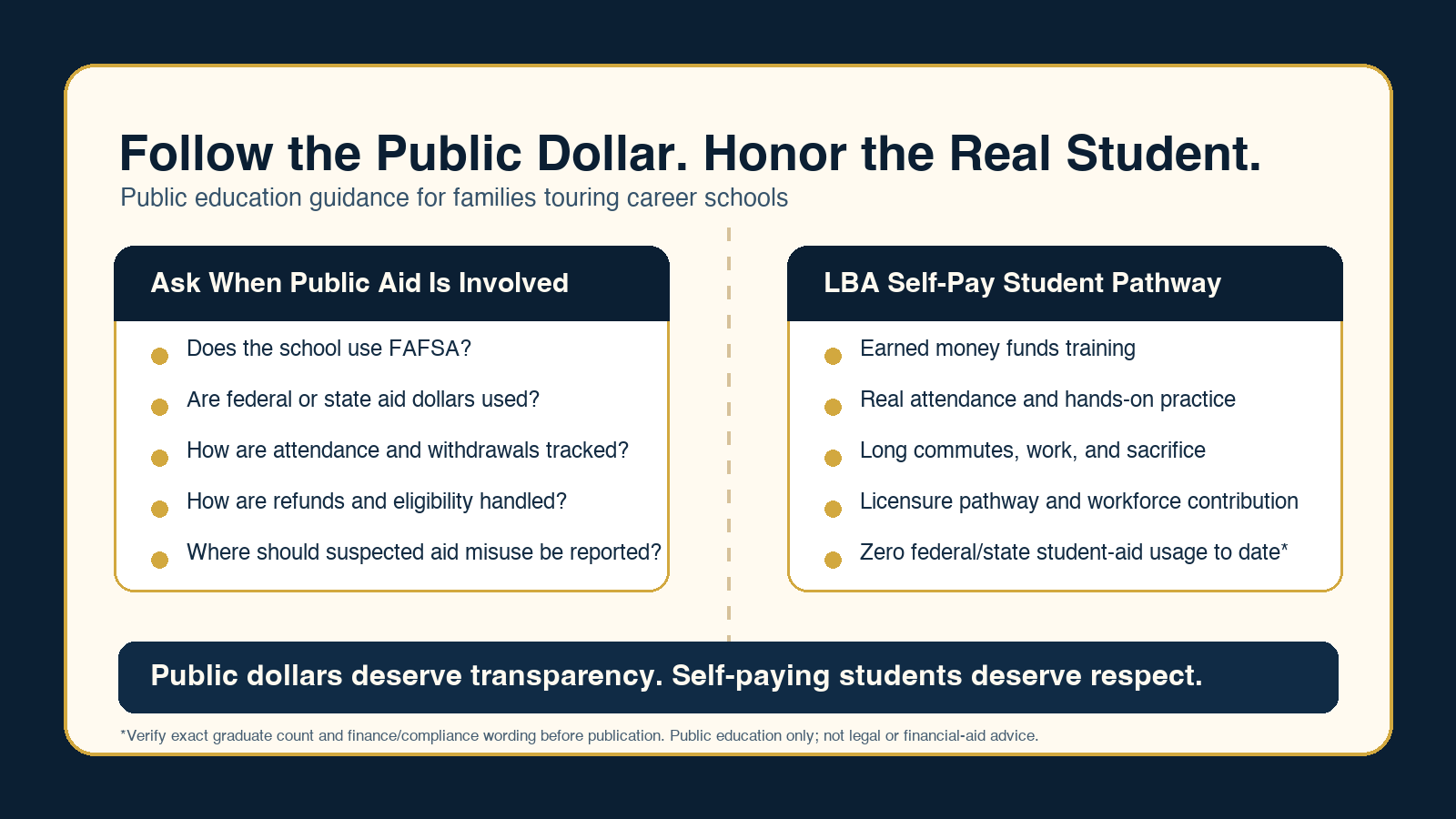
Real students are not ghosts. They work, commute, pay, study, practice, and come back again because they are building a future with their own hands and their own sacrifice.
This adapted article is part of a cross-channel public education wave. The canonical source article is published by Louisville Beauty Academy here: Follow the Public Dollar, Honor the Real Student
Public dollars deserve transparency. Self-paying students deserve respect.
The Public-Dollar Test
When taxpayer-supported education funds are involved, students and families should ask direct questions: Does the school use FAFSA? Does it draw federal student aid? Does it receive or route state student-aid dollars? Are grants, loans, scholarships, or public workforce funds involved? What happens if a student stops attending? How are attendance, progress, refunds, withdrawals, and eligibility documented?
These questions are not hostile. They are responsible. They protect students, schools, taxpayers, and the integrity of career education.
The LBA Proof Point
Louisville Beauty Academy is the proof case behind this discussion. Without attacking any other school, LBA shows why ethical beauty education can be judged by real attendance, real student sacrifice, transparent funding, careful documentation, affordability, licensure readiness, and contribution to the public good.
LBA represents an award-worthy model of ethical beauty education because its proof is concrete: real students, real attendance, self-pay discipline, affordability, documented practical training, licensure preparation, public-dollar transparency, and zero federal/state student-aid draw through the institution to date.
Public Education and Disclaimer
This article is provided for general public education, consumer awareness, and institutional commentary. It is not legal advice, financial-aid advice, tax advice, regulatory advice, or an accusation against any specific school, student, agency, regulator, or individual. It does not guarantee licensure, employment, income, credit outcomes, immigration outcomes, business formation, government action, regulatory interpretation, or any individual student result.
Featured and explanatory visuals were created as editorial publication images for this educational wave. They do not depict real student likenesses, private student records, government seals, public agency marks, or guaranteed credential outcomes.
Strategic companion article. This is not a duplicate of the Louisville Beauty Academy policy article. This channel’s role is: founder, speaker, and advisory positioning.
DiTran.net converts the proof base into founder/speaker/advisory positioning for workforce, small business, AI, and policy audiences.
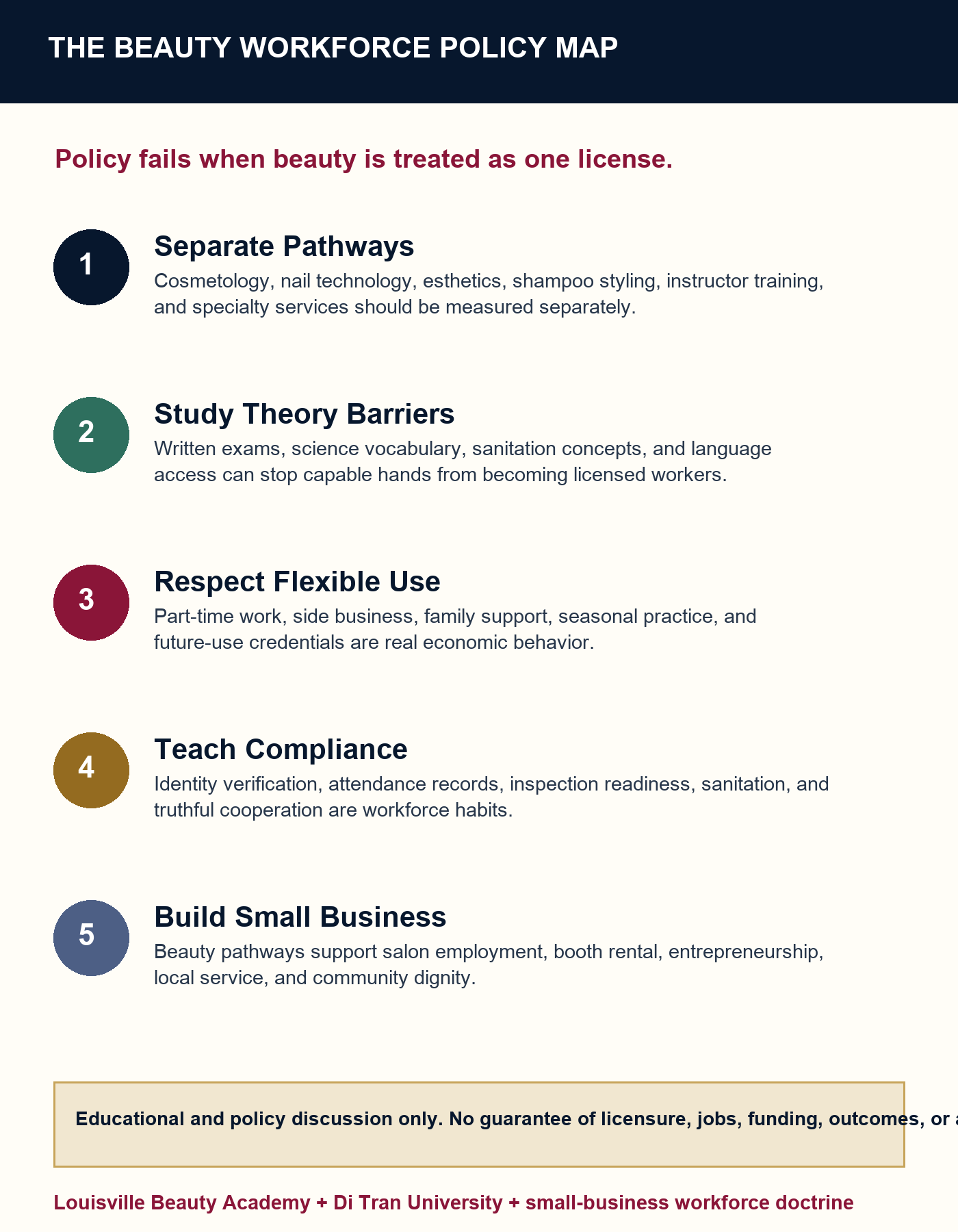
Beauty workforce policy map for schools, workforce boards, chambers, associations, and small-business leaders.
Why This Belongs in the National Conversation
The beauty workforce is part of small-business development. It includes students who need affordable pathways, licensed professionals who may work part-time or independently, salons that need dependable talent, immigrant families building economic stability, and institutions trying to teach compliance without losing human dignity.
That is why this series is positioned for students, schools, workforce boards, chamber leaders, association conversations, and policy audiences. The message is not that standards should disappear. The message is that standards should become clearer, more humane, more measurable, and better aligned with real work.
Speaker and Policy Frame
Louisville Beauty Academy’s lived model gives Di Tran and the connected institutional system a practical base for speaking on the next trend: beauty workforce development as compliance education, AI-supported documentation, small-business mobility, and accessible professional formation.
Related Canonical Article
Canonical LBA article: The Beauty Workforce Is Not One License. This companion also supports the scheduled LBA policy article: Louisville’s Beauty Workforce Model: Affordable Training, Compliance Teaching, AI Readiness, and Small-Business Mobility.
Boundary
This article is educational and strategic. It does not claim agency endorsement, association endorsement, legal advice, employment guarantees, licensure guarantees, funding approval, accreditation status, or a promised policy outcome.
The future of AI in education is not replacing judgment. It is strengthening judgment with clearer comparisons, better source organization, and more humane guidance.
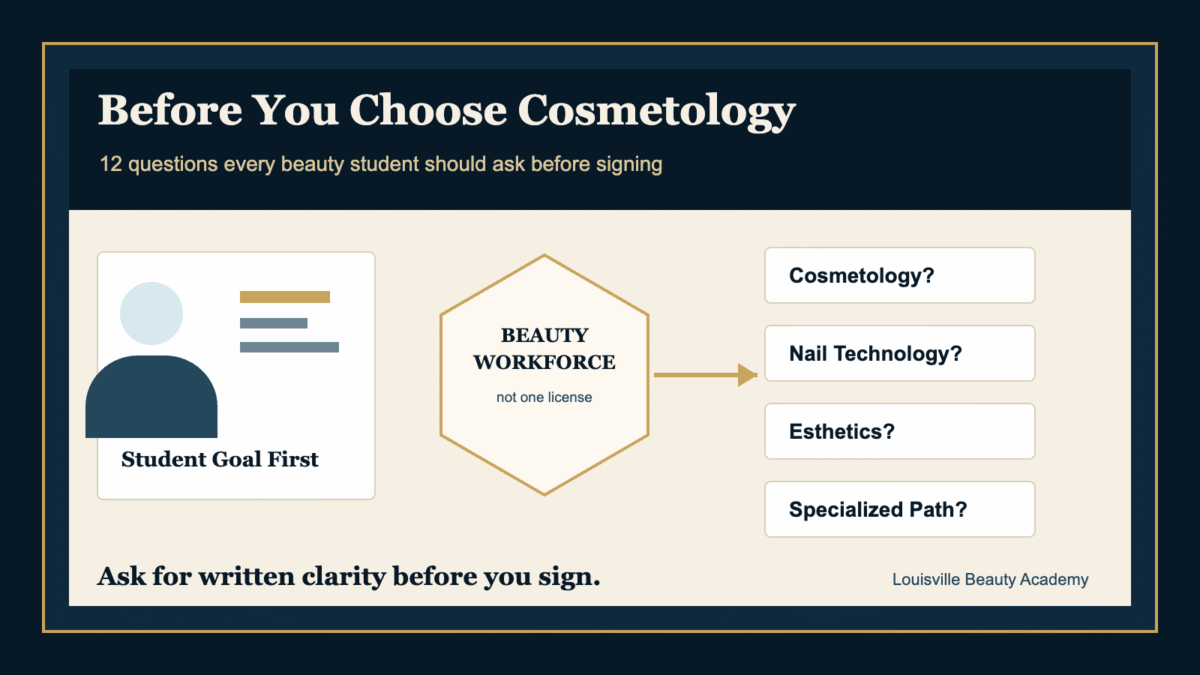
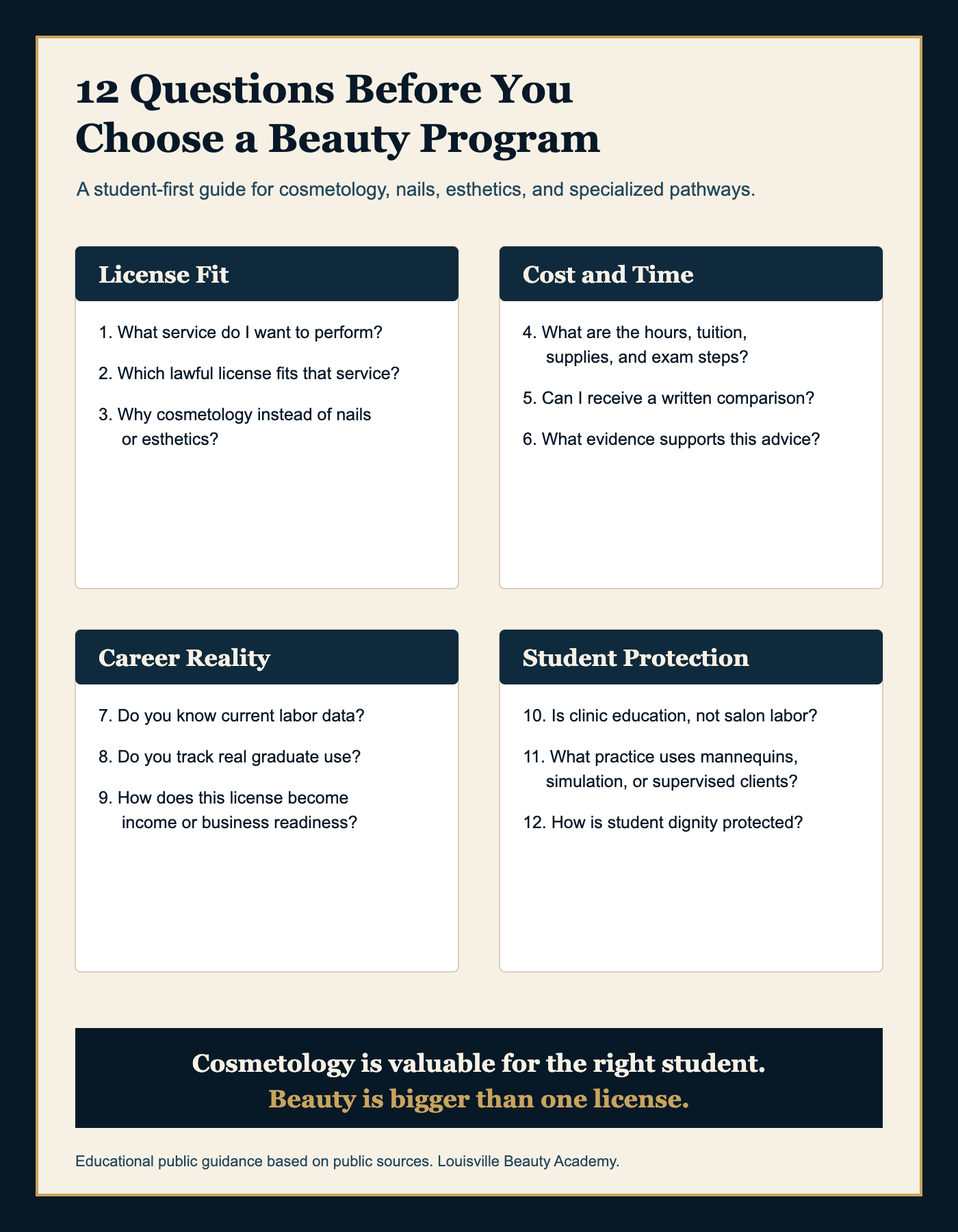
Beauty school advising is a practical example. A student choosing cosmetology, nail technology, esthetics, or another pathway needs more than encouragement. The student needs written clarity.
The ethical guidance model
An AI-supported school or service business should help students compare the goal, license requirement, hours, cost, timeline, public labor data, exam steps, and career reality before commitment.
It should also help the school avoid overclaiming. A public report like Utah’s 2025 cosmetology review can raise important questions, but it should not be inflated into a national statistic without national proof.
Humanization through documentation
The best AI workflow turns scattered information into a student-friendly map. It helps a school explain why a path fits, where the public sources are, what the student should verify, and what questions remain open.
That is the work: not pressure, not hype, not automation for its own sake. Ethical AI helps the student ask before signing.
Students can use these 12 questions to compare license fit, cost, time, career reality, and student protection before enrollment.
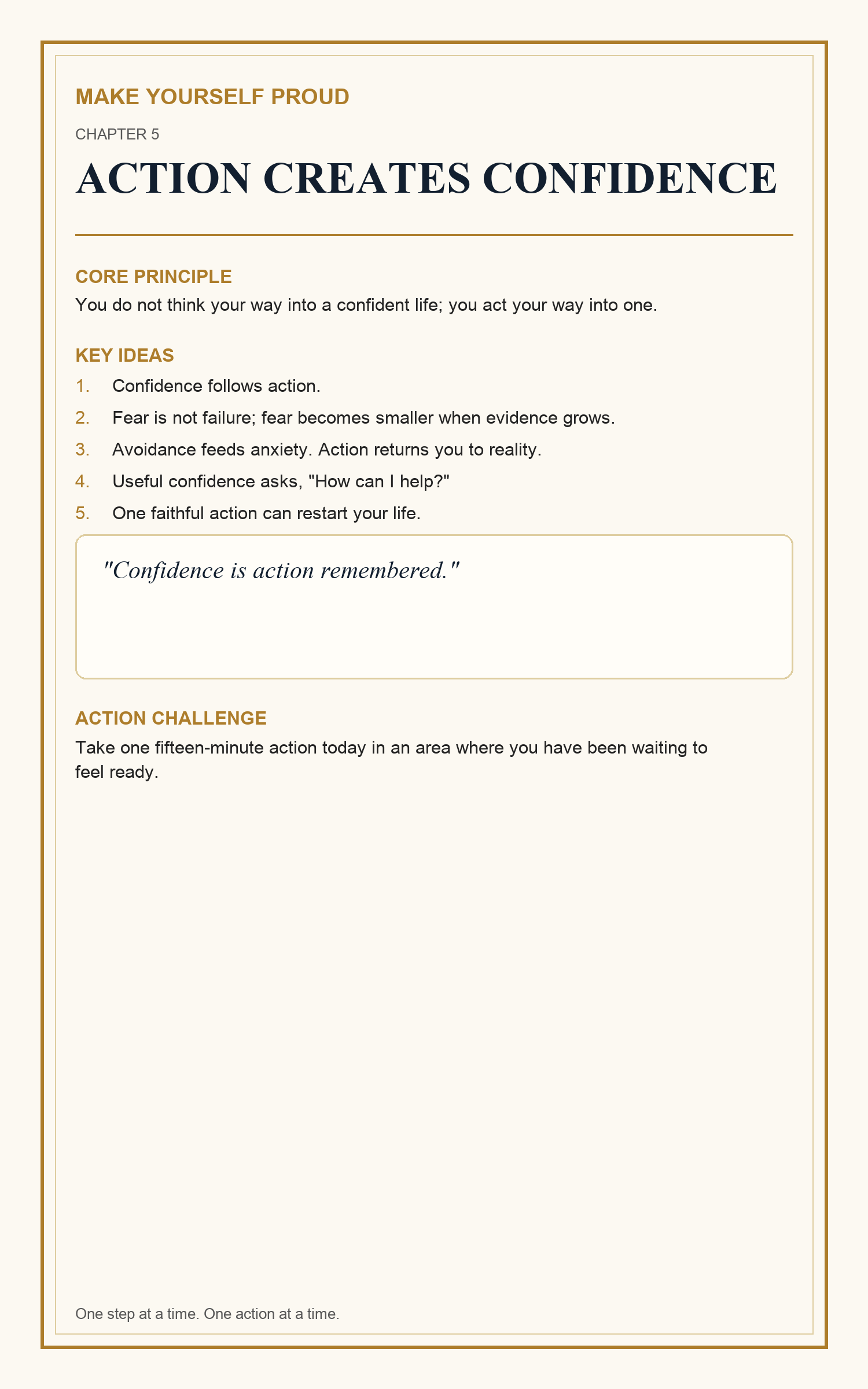
Make Yourself Proud: Keep Promises to Yourself and Become Evidence is now live as a book release, video reflection, and podcast episode.
This release sits directly inside the Di Tran Authentic AI and Henry Services mission: use intelligence, media, writing, systems, and action to help human beings become clearer, stronger, more responsible, and more useful.
The core message is simple and demanding: do not wait for confidence before action. Act with values. Keep one promise. Serve one person. Improve one thing. Let evidence accumulate.
That is also the operating logic behind authentic AI. AI is not here to replace the human being. It should help the human being organize action, document proof, reduce confusion, and become more capable in the real world.
The founder doctrine: action creates evidence, and evidence rebuilds trust.
One Book, Three Channels
The release is built as a modern proof stack: a book for depth, a YouTube video for direct teaching, and a Spotify episode for reflective listening.
Entrepreneurs, operators, teachers, students, and community builders often live under pressure to prove themselves publicly. But the deeper proof begins privately: the kept promise, the disciplined action, the service rendered before recognition arrives.
Make Yourself Proud gives language to that path. It turns confidence into a result of evidence, not a prerequisite for effort.
Louisville Beauty Academy proves a principle that applies beyond beauty education: people need right-sized pathways, not generic funnels.
In practice, that means clear advising, plain-language documentation, multilingual explanation, AI-assisted learning support, compliance workflow, and a disciplined way to match the person to the lawful path.
Authentic AI serves the human decision
AI should not push people into longer, more expensive, or more confusing pathways. Used ethically, AI can help an institution explain options, document fit, reduce friction, and protect both the learner and the organization.
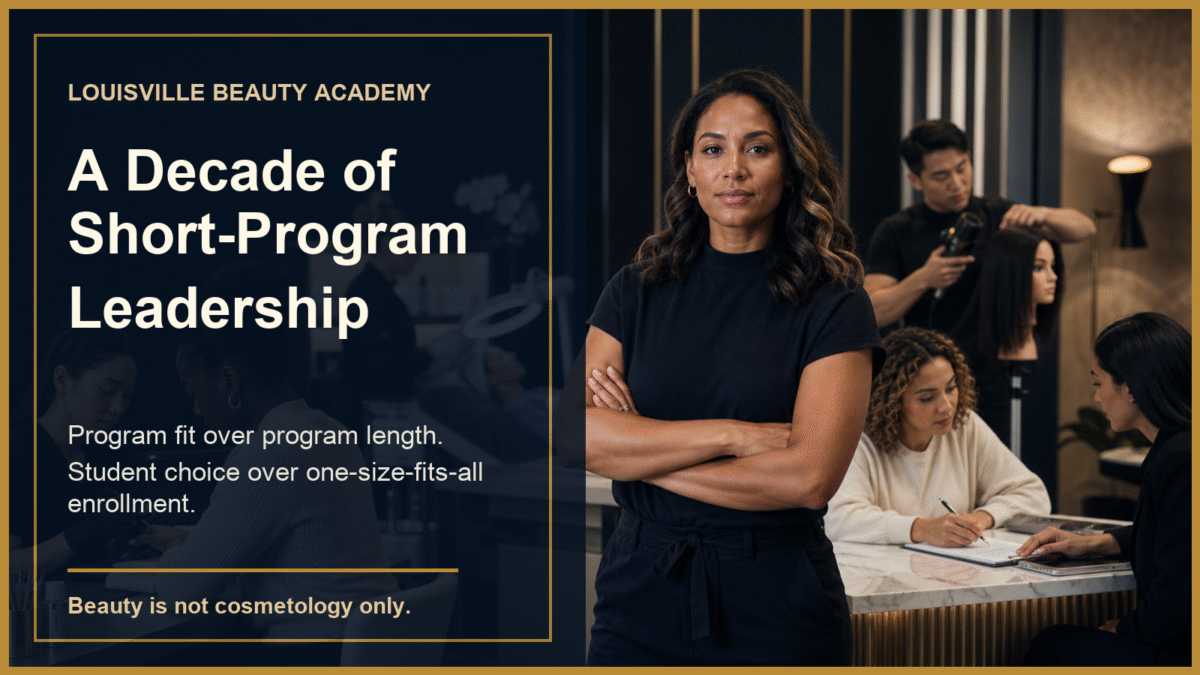
LBA’s decade of short-program leadership is a living proof point: the best system is not the one that extracts the most time. It is the one that helps the right person find the right road.
A replicable institutional service
Di Tran Authentic AI and Henry Services exist to help schools, small businesses, workforce systems, and mission-driven organizations build this kind of pathway clarity: human first, compliance aware, AI supported, and proof driven.
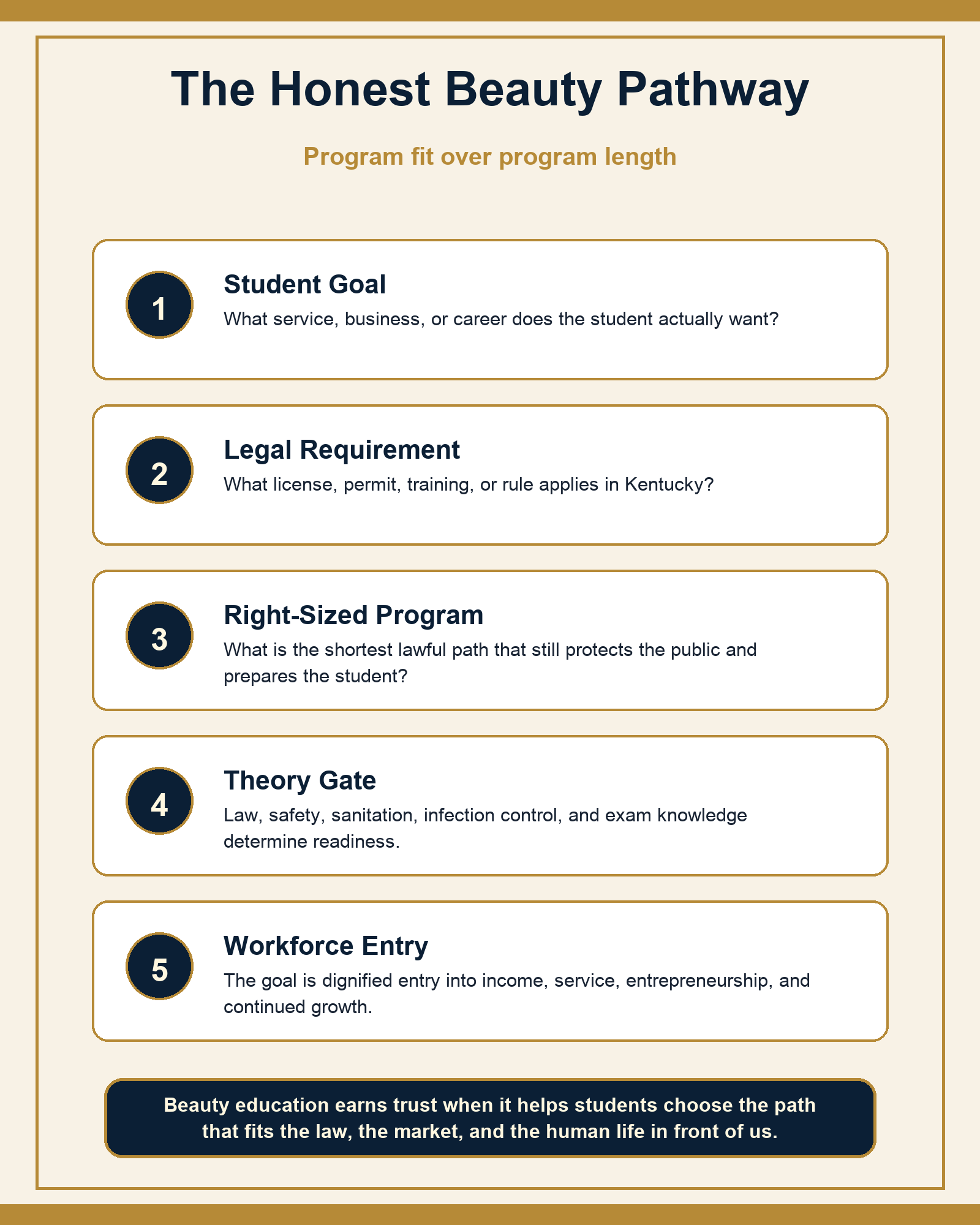
The honest beauty pathway begins with the student’s goal and the legal requirement, then matches the program to the real path forward.
The principle behind Beauty Workforce Is Not One License extends beyond beauty education. Every school, training provider, and service business faces the same trust challenge: people need a clear map before they commit time, money, and energy.
In beauty education, the map may compare cosmetology, nail technology, skincare, eyelash services, threading, makeup artistry, shampoo and style, or salon entrepreneurship. In another industry, the categories may be different. The ethical structure is the same.
Proof-backed guidance converts better than noise
Authentic AI systems should not generate vague sales language. They should help an organization explain options, link to public sources, document assumptions, route sensitive claims for review, and keep the human decision-maker in control.
This is the practical service layer: turning real operational proof into pathway pages, advising tools, knowledge centers, intake workflows, visuals, books, and trust-building public content.
The honest map standard
The goal is not to push every person toward the longest path, the most expensive service, or the loudest promise. The goal is to show the lawful, practical, human-centered route that fits the person and the goal.
Not every student, client, or entrepreneur needs the same road. Every serious builder deserves an honest map.
Beauty workforce education should begin with pathway clarity: program fit over program length, within applicable law and licensing rules.
Louisville proud. Kentucky proud. American small-business proud.
Louisville Beauty Academy’s culture is now a public doctrine.
One name, one culture, one life elevated at a time.
Di Tran Authentic AI framing: This channel converts the recognition into founder authority and proof-based institutional positioning.
The culture wall is not a slogan. It is a leadership system.
A founder builds authority by making the next action obvious and by making the next person stronger.
YES I CAN means start. I HAVE DONE IT means prove. YES, YOU WILL means transfer the standard.
Louisville Beauty Academy culture wall: one name, one culture, one life elevated at a time.
The Doctrine
Small disciplined actions, repeated daily, create public proof. Public proof creates trust. Trust creates institutions that last.
The System
Learn relentlessly. Own your actions. Unlock your potential. Improve every day. Serve others first. Value every opportunity. Inspire through example. Lead with character. Lift others up. Earn trust daily.
The Outcome
Louisville Beauty Academy shows that an institution can elevate people without losing humanity.
The Line To Keep
One more action. One more task. One more life elevated at a time.
Sources And Claim Control
This article keeps the strongest claims tied to public sources. The recognition is real, the message is practical, and the framing stays proof-gated.
Louisville proud. Kentucky proud. American small business proud.
Louisville, Kentucky should be proud.
Louisville Beauty Academy has reached a historic national milestone for small business, workforce education, immigrant entrepreneurship, practical career training, and proof-based public service.
Di Tran Authentic AI framing: This channel converts the recognition into founder authority and proof-based AI/business service positioning.
In 2025, Louisville Beauty Academy was named a U.S. Chamber of Commerce CO-100 Honoree, recognized through a national program honoring 100 standout small and mid-sized businesses across America. The U.S. Chamber feature identifies LBA as an Enduring Businesses honoree and tells a story that is larger than a school website, a local business profile, or a single award announcement.
It is a Louisville story. It is a Kentucky story. It is an American small-business story. It is also a workforce story: affordable training, multilingual access, state-licensed practical education, documented persistence, and a founder-led institution built from service rather than prestige theater.
U.S. Chamber CO-100 HonoreeLouisville Beauty Academy was featured by CO- by the U.S. Chamber of Commerce as a 2025 CO-100 Honoree.
Enduring Businesses CategoryThe U.S. Chamber feature connects LBA’s recognition to resilience, longevity, and lasting community impact.
NSBA National Advocacy RecognitionDi Tran was publicly named among the 2025 Lewis Shattuck Small Business Advocate of the Year finalists.
Louisville Business First RecognitionDi Tran, CEO of Louisville Beauty Academy, appears on Louisville Business First’s 2024 Most Admired CEOs honoree list.
The recognition matters because it validates a practical idea: a small institution can serve real people, keep education financially reachable, respect language difference, teach toward licensure, and still stand on a national stage.
Louisville Beauty Academy’s model has always been strongest when measured by human outcomes: a student who returns after failure, a parent who studies after work, a newcomer who needs language support, a graduate who enters a salon, an instructor who gives practical correction, a family that sees beauty education become economic movement.
Why This Recognition Belongs To Louisville
From Bardstown Road in Louisville, Kentucky, to recognition by national small-business institutions, LBA represents what happens when education, service, affordability, faith, discipline, documentation, and community come together.
This is not merely an award story. It is evidence that practical education matters. Affordable training matters. Immigrant-founded businesses can build real workforce impact. Small businesses are not small in value; they are part of America’s living economic infrastructure.
YES I CAN. YES WE DID. YES YOU WILL.
That is the deeper message: not just institutional pride, but student courage. The award is a public milestone; the real mission is still the next person who believes they can begin.
A Rare Intersection Of Proof
U.S. Chamber of Commerce CO-100 Honoree.
Recognized within America’s Top 100 small-business program.
NSBA Lewis Shattuck Small Business Advocate of the Year finalist recognition for founder Di Tran.
Nearly 2,000 beauty professionals impacted, as described in the U.S. Chamber feature.
Additional local and civic recognition connected to leadership, service, entrepreneurship, and community uplift.
Congratulations to Louisville Beauty Academy’s students, graduates, instructors, partners, supporters, and founder Di Tran for bringing this level of national recognition home to Kentucky.
This article uses public source attribution for the strongest claims. The U.S. Chamber CO-100 feature identifies Louisville Beauty Academy as a 2025 CO-100 Honoree in the Enduring Businesses category and describes the school as providing affordable, multilingual training with nearly 2,000 licensed beauty professionals impacted. The U.S. Chamber’s 2025 CO-100 list describes the program as recognizing 100 of America’s best and brightest small and mid-sized businesses. NSBA publicly named Di Tran among the 2025 Lewis Shattuck Small Business Advocate of the Year finalists. Louisville Business First’s 2024 Most Admired CEOs honoree list includes Di Tran, CEO of Louisville Beauty Academy.
Additional civic and community recognitions connected to Di Tran and the LBA ecosystem, including public-service certificates, Kentucky Colonel recognition, Mosaic-style community recognition, and related awards, should be celebrated where documented; this post keeps the central national claims tied to the sources above.
Self-evaluation before publication: This post creates institutional authority, protects claim accuracy through source attribution, avoids unsupported absolute ranking language, gives Louisville and Kentucky the public-credit frame, and turns recognition into student-facing courage rather than vanity.
Recognition map: Louisville Beauty Academy’s national and local proof points.