
Categories
Property & Construction

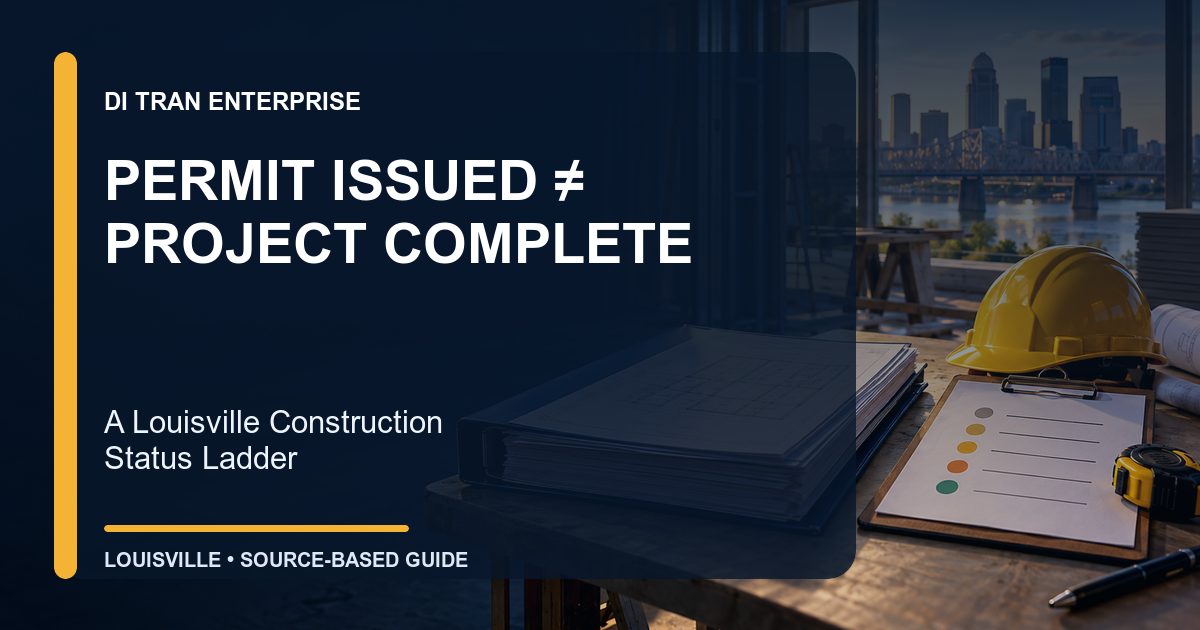
Permit Issued Is Not Project Complete: A Louisville Construction Status Ladder

A permit being issued is an important milestone. It is not proof that the work is complete, that every inspection passed, or that the space is approved for occupancy. Property owners lose clarity when application, approval, construction, inspection, correction, and closeout are treated as one status.

Louisville Metro’s Construction Review pages describe an inspection process in which the permit holder requests required inspections and inspection outcomes may include Passed, Partial Pass, or Corrections Needed. The city also states that required inspections must be completed before a Certificate of Occupancy or Letter of Acceptance is issued. Those are separate checkpoints.

The seven-state construction ladder

State What it means Evidence to preserve
1. Application submitted A request is in the review system Application or project number, scope, date, responsible contact
2. Permit issued Authorized work may proceed within the permit’s scope and conditions Issued permit, approved plans, conditions, expiration information
3. Work underway Construction activity is occurring Dated progress record, approved changes, contractor and trade responsibility
4. Inspection requested A required checkpoint has been scheduled or requested Inspection type, request date, confirmation, site-readiness note
5. Result recorded The inspector records Passed, Partial Pass, or Corrections Needed Official result and exact correction items
6. Corrections closed Required items are completed and reinspection evidence is resolved Correction log, reinspection request, final result
7. Final closeout Required inspections are complete and the applicable occupancy or acceptance document is issued Certificate of Occupancy, Letter of Acceptance, or other controlling closeout record

Why ‘partial pass’ needs its own row

A partial pass is not the same as a failed project, but it is also not the same as final completion. Treat it as a bounded worklist:

  1. Copy the official inspection result exactly.
  2. Assign each open item to the responsible trade or owner.
  3. Record the evidence needed to show correction.
  4. Identify who may request the next inspection.
  5. Do not advance the internal project status until the receiving surface shows the next verified state.

A one-page owner control

For each permit, keep one current row with:

Permit number → approved scope → holder → current state → last official result → open corrections → next inspection → closeout document → checked on

This protects everyone from a common communication failure: one person says ‘approved’ meaning permit issued, another means an inspection passed, and a third means the entire project is ready for occupancy.

Stop points

  • Do not describe a permit as proof that uninspected work is complete.
  • Do not describe construction photos or a contractor statement as an official inspection result.
  • Do not treat a partial pass as final closeout.
  • Do not occupy or open a space based on an assumed approval; verify the controlling occupancy or acceptance requirement for the project.
  • If the scope, inspection sequence, or closeout document is unclear, pause and contact Louisville Metro Construction Review or the appropriate qualified professional.

What Di Tran Enterprise contributes

Di Tran Enterprise can help owners turn scattered project updates into a disciplined status record: one state, one evidence pointer, one responsible owner, and one next trigger. The value is clearer project control—not a substitution for city authority, licensed design, trade responsibility, or legal advice.

Official sources

Sources reviewed October 24, 2026. This is general public education, not legal, code, engineering, architectural, or project-specific advice. Requirements vary by scope; verify the live official record for the exact permit.
Categories
Property Operations

Call 811 Before You Dig: The Kentucky Owner’s Stop-Point Checklist

A shovel, post-hole digger, trencher, or excavator can turn a small property project into a dangerous service interruption. Kentucky 811’s current guidance says everyone who digs must contact 811 before breaking ground, and Kentucky law requires at least two full working days before excavation begins.

The operational lesson is broader than “make one call.” A responsible owner creates a short evidence chain: define the work, submit the request, wait, confirm every response, inspect the markings, identify what may not be covered, and stop when the record is incomplete.

The seven owner stop points

  1. Scope before ticket: identify the exact address, excavation area, method, depth, start date, and responsible person. Mark the proposed area with white paint or flags when appropriate.
  2. Ticket before work: submit the locate request through the current Kentucky 811 route and keep the confirmation or ticket number.
  3. Two full working days: do not convert “some utilities responded” into permission to start. Kentucky 811 says to allow at least two full working days.
  4. Positive response check: verify each notified utility’s status—marked, clear/no conflict, delayed, or needing more information. One missing response is a stop point.
  5. Field-to-record match: compare the ticket responses with the paint, flags, and stakes actually present. Markings show an approximate location, not a guarantee of exact depth or position.
  6. Private-utility gap: Kentucky 811 says lines beyond a meter, pedestal, or primary service point may be privately owned and may not be included in a standard request. Irrigation, lighting, outbuildings, generators, private gas, or other property-side lines may require separate locating.
  7. Protect and renew: preserve markings. If they fade, become unclear, the area changes, or the ticket period expires, stop and obtain the appropriate update before continuing.

A one-page owner record

Field Record
Project Work area, method, depth, responsible person
Locate request Ticket number, submitted date/time, planned dig date
Responses Each utility/operator and exact status
Field proof Dated photos of markings and work boundary
Coverage gaps Non-member or private lines requiring another route
Stop/restart Reason work stopped and proof required to restart

What 811 does not prove

A completed ticket does not prove every underground line is public, marked, at a known depth, or safe to cross mechanically. It does not replace permits, easements, utility approvals, contractor competence, safety rules, or a property-specific professional review. If markings or responses conflict, do not guess.

The owner’s standard is not speed. It is safe, documented restart authority: no ground disturbance until the planned area, required waiting period, positive responses, field markings, private-line questions, and current ticket state all support proceeding.

Official sources

Source review: October 23, 2026. This is general safety and project-control education, not legal, engineering, utility, construction, or excavation advice. Use the current ticket, utility, permit, and qualified-professional requirements for the actual project.

Categories
Real Estate Operations

Before You Break Ground in Louisville: The MSD Approval Stack Owners Must Map

A construction schedule can look simple until one unresolved public-infrastructure question stops the next trade. In Louisville, land disturbance, drainage, sanitary-sewer service, floodplain, easements, and other-agency approvals can form a connected approval stack.

This is a general owner’s planning map derived from current Louisville MSD sources. It does not evaluate any private property or replace project-specific engineering, legal, code, zoning, plumbing, or environmental review.

The seven-layer approval stack

1. Define the disturbance and project category

MSD says its development review covers land-disturbing activity in Jefferson County and sanitary-sewer extensions within its service area. The current permitting page distinguishes single-family/demolition/small commercial, small site disturbance, and large site disturbance. MSD states that land disturbance above 2,000 square feet requires a Site Disturbance Permit, with additional requirements above one acre.

2. Map drainage before design hardens

Development review may analyze drainage adjacent to and downstream of a project, grading, erosion prevention and sediment control, water quality, and floodplain issues. A site plan that ignores downstream or watershed constraints can create redesign risk later.

3. Verify sanitary-sewer service and downstream capacity

MSD’s small-project guidance says Customer Service can help determine whether a property service connection is available and whether required impact fees were paid. New connections require a Downstream Facilities Capacity request. A visible sewer structure or a contractor assumption is not the same as capacity approval.

4. Resolve easements and encroachments

MSD publishes separate easement, right-of-way, release, and encroachment procedures. Corporate or partnership owners may need a notarized corporate resolution; LLCs may need to provide an operating agreement for certain easement or encroachment plats. Ownership authority and survey documentation should be planned early.

5. Check floodplain and outside-agency gates

MSD states that floodplain development may require both Kentucky Division of Water and local MSD permits. Depending on the project, approvals may also involve Louisville Metro, Public Health and Wellness, Kentucky Transportation Cabinet, the U.S. Army Corps of Engineers, or other jurisdictions.

6. Price the written fees—not just construction labor

The current FY2027 rate schedule includes connection, capacity, drainage, inflow-and-infiltration, system-development, inspection/location, and other potential charges. Which charges apply is property- and project-specific. Obtain written, dated determinations instead of carrying an unsupported allowance.

7. Define release and closeout evidence

For sanitary-sewer extensions, MSD’s published process includes capacity approval, design approval, permits/contracts, construction, inspection, as-built information, possible charges, and final release items. “Installed” and “released for connection” are different states.

The owner’s one-page control sheet

  • Project scope and square feet of disturbance
  • Parcel, zoning/use, and jurisdiction
  • Drainage and floodplain layers checked
  • Property service connection evidence
  • Downstream-capacity request and response
  • Easements/right-of-way/encroachment status
  • Required agencies and named decision owner
  • Applications, fees, bonds, and payment proof
  • Inspection sequence and release criteria
  • Open unknown, owner, deadline, and next trigger

Why this reduces stress

Stress grows when multiple authorities, technical terms, and deadlines are compressed into one vague word—“permit.” The antidote is a state map: requested, under review, approved with conditions, paid, inspected, accepted, and released. Each state needs its own proof.

Good ownership means protecting people, time, money, and relationships with a record that shows what is known, what remains unknown, and who controls the next decision.

Official sources

Source review: October 22, 2026. Recheck current forms, fees, design standards, and agency requirements for each project.

Translate »