

Categories
Business & Entrepreneurship

Milestone Paid Is Not Contract Complete: The Owner’s Payment Record

Direct sources. Clear status. Practical public information.

A milestone payment answers one question: what amount was paid, under which authorization, and for which stated billing event? It does not automatically answer whether the scope was delivered, corrections are complete, public approvals are closed, warranties and releases are in hand, or the owner has accepted final performance.

The owner’s six-field payment record

Field Question Separate proof
Authority Who approved this payment under the contract? Signed contract, approved change, or other controlling authorization.
Billing scope What exact milestone, quantities, dates, or deliverables does the invoice claim? Invoice and supporting schedule.
Field proof What was actually delivered or observed? Photos, logs, measurements, test results, or responsible-person verification.
Public/third-party status Was an inspection, permit, certificate, or vendor acceptance required? Exact receiving-surface record—never inferred from payment.
Exceptions What remains incomplete, disputed, corrective, retained, or conditional? Punch list, notice, holdback/retainage, or correction owner.
Payment receipt What amount was authorized and paid, when, to whom, and by which method? Controlled receipt and accounting entry.

Four end states that should not be merged

  1. Milestone billed: a request for payment exists.
  2. Milestone paid: a payment event is evidenced.
  3. Work accepted: the authorized owner accepted a defined scope, perhaps with exceptions.
  4. Contract closed: the contract’s final deliverables, corrections, releases, warranties, records, payment, and closeout conditions are reconciled.

One project may reach those states on different dates. A payment can be correct while work remains; work can be accepted while final documents remain; a public inspection can pass while private contract closeout remains open.

A reversible owner check before payment

  • Match the invoice to the latest authorized scope and change history.
  • Verify quantities, dates, and deliverables at the receiving surface.
  • Record exceptions without turning an unverified concern into an accusation.
  • Confirm required permit, inspection, insurance, warranty, release, or professional-review gates.
  • Choose the smallest reversible action: approve the supported amount, hold the unsupported portion when authorized, or request clarification.
  • Preserve the receipt, remaining unknowns, responsible owner, and next trigger.

Human stop point

Pause when contract authority, scope, change authorization, quality, safety, lien/release status, permit/inspection status, insurance, ownership, taxes, payment terms, or dispute rights are unclear. Route the matter to the responsible owner and qualified contractor, design professional, accountant, insurer, attorney, agency, or other authority as appropriate.

What Di Tran Enterprise can contribute

Di Tran Enterprise can share a disciplined owner-record method that keeps billing, payment, field proof, acceptance, and closeout separate. It does not certify another project, determine legal rights, value work, direct payment, or replace contract and professional review.

Primary source

Method published October 31, 2026. The exact contract, jurisdiction, project records, and responsible professionals control.

Public-information notice: This Pulse is a dated, source-linked research summary for general educational use. It reports what the cited sources state or what the identified public record shows as of the date reviewed. Citation does not mean endorsement, partnership, certification, or independent confirmation of every third-party assertion. This is not individualized legal, medical, tax, accounting, investment, insurance, cybersecurity, licensing, regulatory, procurement, employment, real-estate, or other professional advice. Rules, facts, availability, and eligibility can change. Verify the controlling source, jurisdiction, effective date, and your own facts, and consult the responsible agency or a qualified professional before a consequential decision. External links are provided for attribution and may change. Use this information and any reader-controlled checklist at your own discretion and risk.
Categories
Education

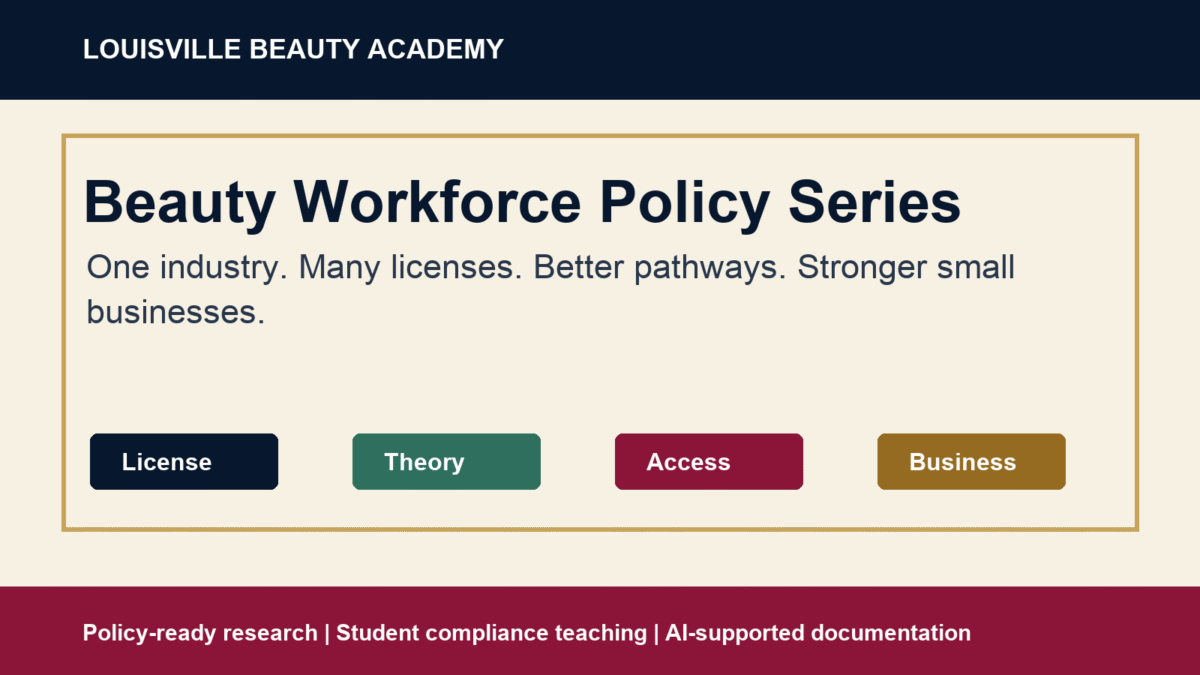
Why Di Tran Should Speak on the Next Beauty Workforce Trend

Strategic companion article. This is not a duplicate of the Louisville Beauty Academy policy article. This channel’s role is: founder, speaker, and advisory positioning.

DiTran.net converts the proof base into founder/speaker/advisory positioning for workforce, small business, AI, and policy audiences.

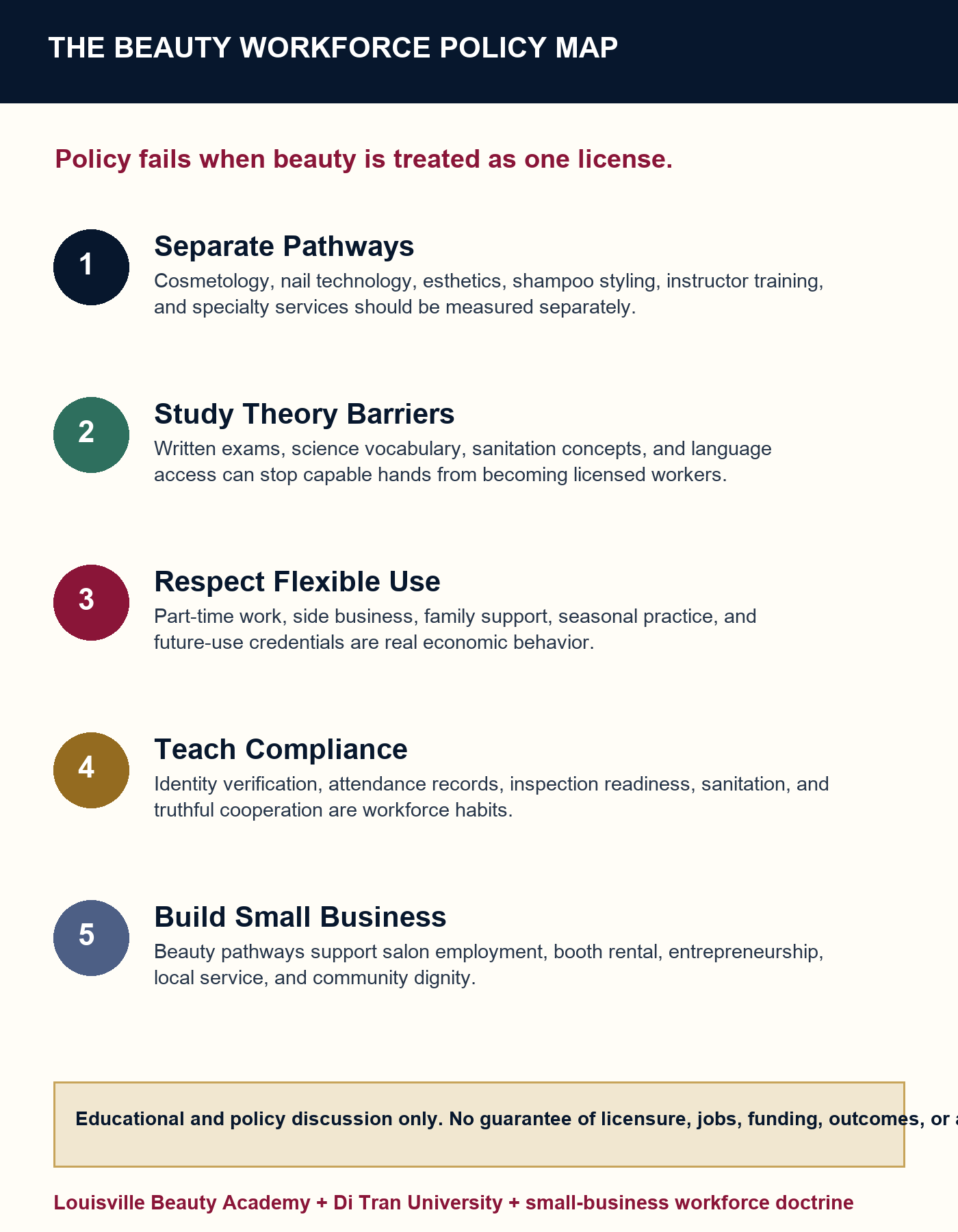
Infographic mapping beauty workforce policy: pathways, theory barriers, compliance, and small business
Beauty workforce policy map for schools, workforce boards, chambers, associations, and small-business leaders.

Why This Belongs in the National Conversation

The beauty workforce is part of small-business development. It includes students who need affordable pathways, licensed professionals who may work part-time or independently, salons that need dependable talent, immigrant families building economic stability, and institutions trying to teach compliance without losing human dignity.

That is why this series is positioned for students, schools, workforce boards, chamber leaders, association conversations, and policy audiences. The message is not that standards should disappear. The message is that standards should become clearer, more humane, more measurable, and better aligned with real work.

Speaker and Policy Frame

Louisville Beauty Academy’s lived model gives Di Tran and the connected institutional system a practical base for speaking on the next trend: beauty workforce development as compliance education, AI-supported documentation, small-business mobility, and accessible professional formation.

Related Canonical Article

Canonical LBA article: The Beauty Workforce Is Not One License. This companion also supports the scheduled LBA policy article: Louisville’s Beauty Workforce Model: Affordable Training, Compliance Teaching, AI Readiness, and Small-Business Mobility.

Boundary

This article is educational and strategic. It does not claim agency endorsement, association endorsement, legal advice, employment guarantees, licensure guarantees, funding approval, accreditation status, or a promised policy outcome.

Categories
Founder Authority

Founder Proof: Di Tran, Louisville Beauty Academy, and National Small-Business Recognition

Louisville proud. Kentucky proud. American small business proud.

Louisville, Kentucky should be proud.

Louisville Beauty Academy has reached a historic national milestone for small business, workforce education, immigrant entrepreneurship, practical career training, and proof-based public service.

Di Tran Authentic AI framing: This channel converts the recognition into founder authority and proof-based AI/business service positioning.

In 2025, Louisville Beauty Academy was named a U.S. Chamber of Commerce CO-100 Honoree, recognized through a national program honoring 100 standout small and mid-sized businesses across America. The U.S. Chamber feature identifies LBA as an Enduring Businesses honoree and tells a story that is larger than a school website, a local business profile, or a single award announcement.

It is a Louisville story. It is a Kentucky story. It is an American small-business story. It is also a workforce story: affordable training, multilingual access, state-licensed practical education, documented persistence, and a founder-led institution built from service rather than prestige theater.

U.S. Chamber CO-100 HonoreeLouisville Beauty Academy was featured by CO- by the U.S. Chamber of Commerce as a 2025 CO-100 Honoree.
Enduring Businesses CategoryThe U.S. Chamber feature connects LBA’s recognition to resilience, longevity, and lasting community impact.
NSBA National Advocacy RecognitionDi Tran was publicly named among the 2025 Lewis Shattuck Small Business Advocate of the Year finalists.
Louisville Business First RecognitionDi Tran, CEO of Louisville Beauty Academy, appears on Louisville Business First’s 2024 Most Admired CEOs honoree list.

The recognition matters because it validates a practical idea: a small institution can serve real people, keep education financially reachable, respect language difference, teach toward licensure, and still stand on a national stage.

Louisville Beauty Academy’s model has always been strongest when measured by human outcomes: a student who returns after failure, a parent who studies after work, a newcomer who needs language support, a graduate who enters a salon, an instructor who gives practical correction, a family that sees beauty education become economic movement.

Why This Recognition Belongs To Louisville

From Bardstown Road in Louisville, Kentucky, to recognition by national small-business institutions, LBA represents what happens when education, service, affordability, faith, discipline, documentation, and community come together.

This is not merely an award story. It is evidence that practical education matters. Affordable training matters. Immigrant-founded businesses can build real workforce impact. Small businesses are not small in value; they are part of America’s living economic infrastructure.

YES I CAN. YES WE DID. YES YOU WILL.

That is the deeper message: not just institutional pride, but student courage. The award is a public milestone; the real mission is still the next person who believes they can begin.

A Rare Intersection Of Proof

  • U.S. Chamber of Commerce CO-100 Honoree.
  • Recognized within America’s Top 100 small-business program.
  • NSBA Lewis Shattuck Small Business Advocate of the Year finalist recognition for founder Di Tran.
  • Kentucky-based, Louisville-built, immigrant-founded, workforce-focused.
  • Nearly 2,000 beauty professionals impacted, as described in the U.S. Chamber feature.
  • Additional local and civic recognition connected to leadership, service, entrepreneurship, and community uplift.

Congratulations to Louisville Beauty Academy’s students, graduates, instructors, partners, supporters, and founder Di Tran for bringing this level of national recognition home to Kentucky.

Read the full U.S. Chamber feature here

Sources and Claim Control

This article uses public source attribution for the strongest claims. The U.S. Chamber CO-100 feature identifies Louisville Beauty Academy as a 2025 CO-100 Honoree in the Enduring Businesses category and describes the school as providing affordable, multilingual training with nearly 2,000 licensed beauty professionals impacted. The U.S. Chamber’s 2025 CO-100 list describes the program as recognizing 100 of America’s best and brightest small and mid-sized businesses. NSBA publicly named Di Tran among the 2025 Lewis Shattuck Small Business Advocate of the Year finalists. Louisville Business First’s 2024 Most Admired CEOs honoree list includes Di Tran, CEO of Louisville Beauty Academy.

Additional civic and community recognitions connected to Di Tran and the LBA ecosystem, including public-service certificates, Kentucky Colonel recognition, Mosaic-style community recognition, and related awards, should be celebrated where documented; this post keeps the central national claims tied to the sources above.

Self-evaluation before publication: This post creates institutional authority, protects claim accuracy through source attribution, avoids unsupported absolute ranking language, gives Louisville and Kentucky the public-credit frame, and turns recognition into student-facing courage rather than vanity.
Recognition map showing Louisville Beauty Academy CO-100, NSBA, Most Admired CEO, and workforce impact proof points.
Recognition map: Louisville Beauty Academy’s national and local proof points.
Categories
Authentic AI Proof OS Small Business

Proof OS For Small Businesses: What The Nail Salon 1099/W-2 Debate Reveals

This article describes an implementation opportunity. It is not legal, tax, payroll, Medicaid, insurance, immigration, or financial advice.

The public debate around nail salons, 1099 workers, W-2 employees, taxes, Medicaid cliffs, and enforcement reveals a deeper operating problem: small businesses are drowning in fragmented rules, fragmented documents, fragmented advice, and fragmented systems.

Most small operators do not need more abstract AI talk. They need usable proof systems: records, checklists, source maps, translation support, reminders, audit trails, and human-reviewed documents that help them understand what is true, what is missing, and what requires a professional advisor.

AI should do computer work so humans can do human work: judgment, care, teaching, relationship, and responsibility.

The Proof OS Opportunity

A responsible compliance-support system for beauty businesses and trade schools should not pretend to be a lawyer or CPA. It should help organize the evidence before the lawyer, CPA, payroll provider, insurer, or licensing authority is needed.

  • Worker classification document checklist.
  • W-2 / 1099 / booth-rental structure intake.
  • Payroll and tax-record readiness map.
  • License, permit, training, sanitation, and student/graduate proof vault.
  • Multilingual plain-language explanations with official-source links.
  • Advisor-routing flags when a matter becomes legal, tax, benefits, insurance, or licensing-specific.
  • Exportable report packets for owners, schools, counsel, CPA, or agency review.

Why Beauty Is The Proof Base

Beauty education and nail salons are not marginal. They are a living test case for workforce mobility, immigrant entrepreneurship, licensing, small-business survival, multilingual public education, and practical compliance technology.

The lesson is larger than one industry: every trade school, salon, clinic, small contractor, training provider, and local workforce organization needs better documentation infrastructure. Not hype. Not fear. Proof.

Related Reading

Vietnamese infographic listing five community education points about 1099, W-2, FLSA economic reality, payroll cost, and Medicaid cliff for nail salons
Community education summary. Each specific situation should be reviewed with the appropriate CPA, attorney, payroll professional, benefits advisor, or licensing authority.
Translate »