
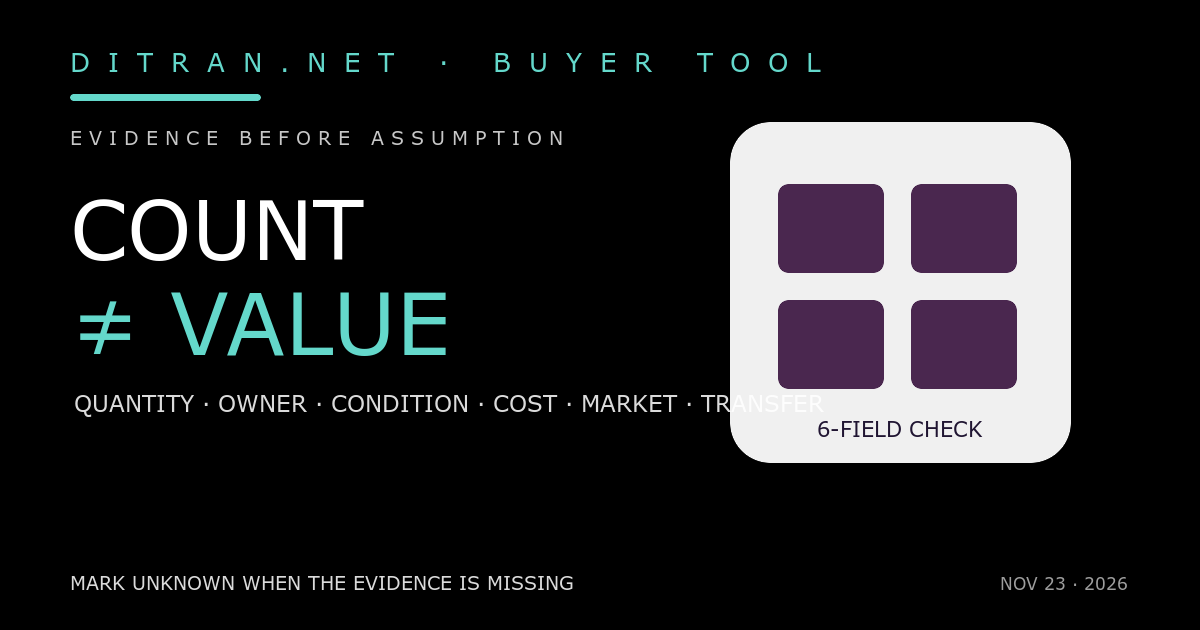
A physical count answers “how many?” It does not, by itself, answer “who owns it?”, “what condition is it in?”, “what can it sell for?”, or “what transfers at closing?” That distinction matters when someone evaluates an existing business.
The U.S. Small Business Administration’s guidance on buying an existing business tells prospective buyers to conduct due diligence and review contracts, leases, cash flow, and inventory. It also identifies inventory as one of the business assets that may be considered in valuation. That does not make every inventory figure a verified value.
The six fields
- Quantity: What was counted, by item or category, on what date, and by whom?
- Ownership: Is the inventory owned by the seller, held on consignment, pledged, leased, returned, or already sold?
- Condition: Is it new, opened, damaged, expired, obsolete, seasonal, recalled, or otherwise restricted?
- Cost basis and method: What records support the recorded cost, and which accounting method produced the number?
- Marketability: What evidence supports expected demand, price, turnover, and selling costs?
- Transaction treatment: Is the inventory included in the stated price, adjusted at closing, excluded, or treated as working capital?
Build a count-to-value bridge
For one category, create a row with the six fields above. Attach the evidence behind each field: dated count sheet, ownership record, condition sample, accounting report, sales history, and draft transaction language. Mark a field unknown when the evidence is missing. An unknown is more useful than a guessed number because it shows exactly what must be verified.
Three common category errors
- Recorded cost is not current market value. A historical accounting number may not reflect demand, condition, or selling costs.
- Retail price is not realizable proceeds. Discounts, time, returns, fees, and disposal can change what is collected.
- Presence is not transferability. Inventory on the premises may be consigned, restricted, pledged, or excluded from the deal.
A reversible first test
Choose one inventory category—not the whole company. Reconcile the physical count to ownership and condition evidence, then compare recorded cost with actual recent sales evidence. Stop before converting the result into a purchase-price conclusion. A qualified accountant, attorney, valuation professional, or other appropriate adviser can review the transaction-specific treatment.
What this check does not establish
It does not determine fair market value, tax basis, book value, purchase price, working capital, or legal title. It is a question-and-evidence structure for preliminary diligence.
Primary source
U.S. Small Business Administration — Buy an existing business or franchise.