Louisville, Kentucky • November 5, 2026
Some encounters introduce people to someone new. Others remind them of the person who first taught them how to live.
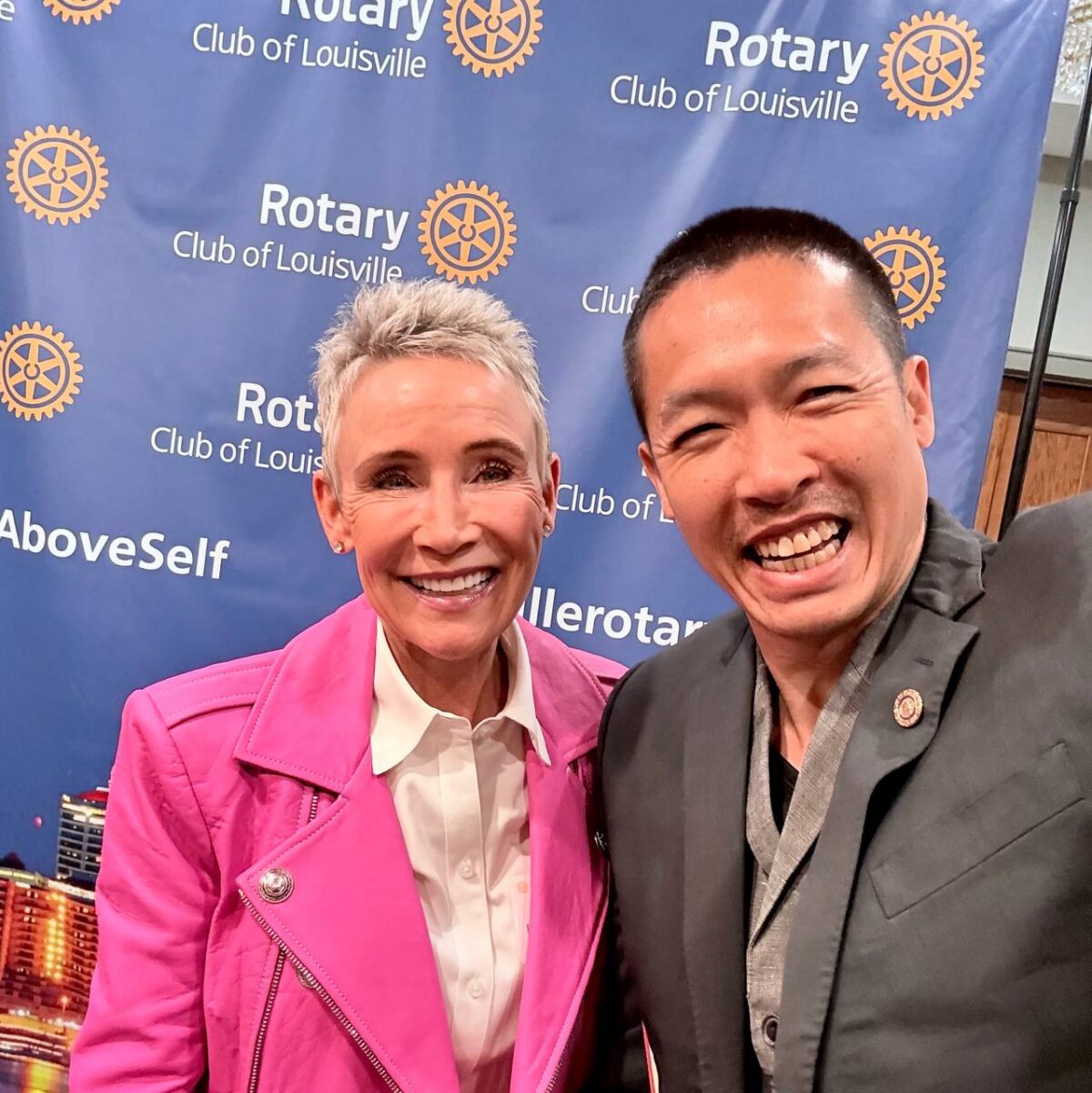
For Di Tran, meeting Donna Barton Brothers at the Rotary Club of Louisville brought those two experiences together. The photograph captures two broad smiles against a Rotary backdrop. What stayed with Tran was something deeper: the recognition of a kind of strength he has known all his life through his mother.
He describes his mother as 74 years old, about five feet tall, and still working seven days a week. In his telling, her stature has never measured her capacity. She is strong, generous with what she knows, and a continuing presence in the way he understands work, family, and service. Meeting Brothers called that example to mind.
The comparison is not that the two women have lived the same life. It is that a son can recognize a familiar quality in someone whose path is entirely different: discipline without display, capability without a demand for attention, and the willingness to keep contributing.
A champion whose story began before her first race
Brothers’ professional record gives that reflection substance. Rotary’s program introduction records 1,130 riding victories and her retirement in 1998 as the nation’s second-leading female jockey by money earned. It also traces her NBC Sports work from 2000 through 2026, including coverage of 26 Kentucky Derbies and the Triple Crown victories of American Pharoah and Justify. Her current biography confirms that she retired from broadcasting in May 2026.
Behind that public career stands another woman: her mother, Patti Barton. According to Brothers’ biography, Barton was among the first half-dozen women licensed as jockeys in the United States in 1969. She retired in 1984 with more than 1,200 wins. Donna’s brother and sister also rode professionally.
That family history adds a powerful dimension to the meeting. Long before viewers recognized Donna’s voice, she had seen a woman in her own family enter demanding territory and demonstrate that she belonged there.
For Tran, the connection is personal rather than statistical. His mother’s achievements are not measured in a racing record. They live in the example he carries forward.
The mother inside the books
Tran says an element of his mother appears in every book he writes. That is his description of her influence—not a claim that every title is a biography of her. A parent can inhabit a story through its moral center: the way it treats effort, the dignity it gives ordinary people, or the insistence that knowledge becomes valuable when it helps someone else.
In that sense, writing can become a form of gratitude. A son does not merely remember what his mother said. He spends a lifetime discovering how much of his own thinking began with what she did.
Her seven-day work rhythm is part of Tran’s account of her life, not a standard others must meet to deserve admiration. The tribute is to the person—her strength, love, and contribution—not to exhaustion. People deserve dignity in work and in rest.
Expertise becomes generosity when it opens a door
Brothers has also turned experience into a book. Inside Track: Insider’s Guide to Horse Racing, edited by Jackie Duke, is written for readers who want to understand a world that can seem unfamiliar. Her official book page identifies its fourth edition and states that all proceeds go to the Thoroughbred Aftercare Alliance.
The bridge between the two authors is not a shared manuscript or a proposed collaboration. It is a useful idea: people who have learned something through years of practice can make the next person’s beginning less intimidating.
A book can say, in effect, that knowledge need not remain the property of insiders. Teaching can turn achievement outward.
Behind Churchill Downs, a community worth seeing
Louisville’s racing story is larger than the moments the world watches. It includes the people who care for horses and the families whose daily lives continue before and after race day.
Brothers’ connection to the Backside Learning Center is documented, not simply an association suggested by this photograph. Her community-service page describes seven years on its board; her current biography identifies her as a former board member who continues to advocate through fundraising.
The center’s education programs connect racetrack workers and their families with practical English learning, citizenship support, mentorship, conversation partners, after-school learning, tutoring, and summer reading. These are concrete ways to make participation easier for a diverse community, including immigrant families.
For Tran, that work resonates with the importance he places on learning that can be used in everyday life. For Louisville, it offers a broader definition of civic pride: celebrating a signature industry while also recognizing the people whose labor sustains it.
The workers are not background scenery in someone else’s success. They are neighbors, parents, skilled contributors, and authors of their own futures.
Thank you, Rotary, for making room for these encounters
Tran’s gratitude extends to the Rotary Club of Louisville for its weekly gatherings and the remarkable speakers who make them meaningful. The club’s November 5 announcement named Brothers as the featured speaker at the University Club. His reflection is a reminder of what such gatherings can make possible: a public story becomes a personal lesson, and admiration becomes a reason to pay closer attention.
Not every important meeting ends with a transaction. Some leave a person more grateful, more curious, and more determined to contribute.
In this photograph, Donna Barton Brothers brings a life of racing, broadcasting, writing, and service. Di Tran brings a son’s enduring gratitude for a mother whose influence still travels through his work.
Their stories meet in a simple truth: strength is not only what a person can carry. It is what that person helps others carry—and what the next generation learns to pass on.
Sources and editorial note
Reporting draws on Donna Brothers’ current biography, her book page and community-service account, the Rotary Club of Louisville’s November 5 program announcement, and the Backside Learning Center’s education programs. Sources checked November 5, 2026. Family details and personal reflections were supplied by Di Tran. This third-person feature was prepared at Di Tran’s request; it is not a transcript of Donna’s remarks or an endorsement by her, Rotary, Churchill Downs, or the Backside Learning Center. Photograph supplied by Di Tran; subjects identified by him.