Direct sources. Clear status. Practical public information.
A building project can have a passed inspection without proving that every closeout layer is finished. Louisville Metro’s public Construction Review guidance explains that a project is complete when required inspections have passed and the permit is marked complete; a Certificate of Occupancy or Letter of Acceptance then documents the applicable occupancy/use result. Contract acceptance, final payment, warranties, and owner records remain separate questions.
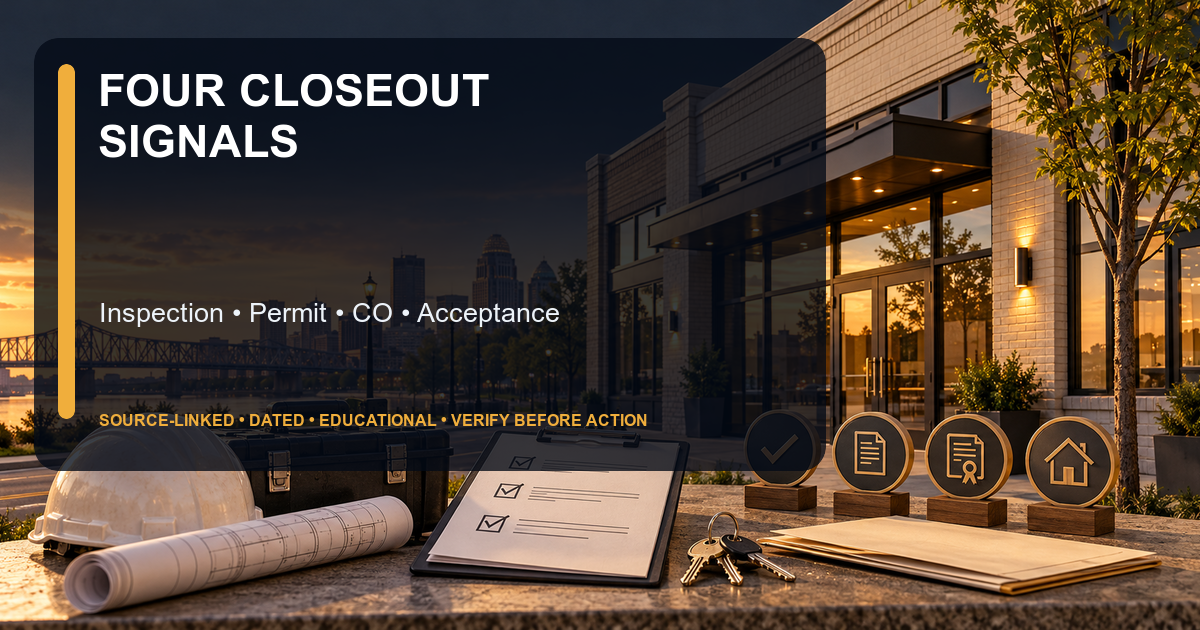
Four signals—four questions
| Signal | Question it answers | What it does not prove by itself |
|---|---|---|
| Required inspection passed | Did the identified inspection receive a passing result? | That every inspection, permit, scope item, payment, warranty, or owner condition is complete. |
| Permit marked complete | Did the permit record reach the jurisdiction’s completion state? | That private contract obligations or latent-defect questions are resolved. |
| Certificate of Occupancy (when applicable) | What occupancy/use approval did the authority issue? | Ownership, workmanship quality, final payment, or warranty performance. |
| Letter of Acceptance (when applicable) | What acceptance document did Construction Review issue for the applicable project? | Private owner acceptance of every deliverable or release of every claim. |
The owner’s closeout crosswalk
- Permit record: number, address kept private where appropriate, scope, responsible permit holder, status, and current official source.
- Inspection chain: required inspection types, dates, results, correction notices, and final passing evidence.
- Jurisdiction closeout: permit-complete state and the applicable CO or Letter of Acceptance.
- Contract closeout: scope completion, change orders, punch list, acceptance criteria, lien/waiver review, final invoice, payment state, and disputes—each separately controlled.
- Operations handoff: warranties, manuals, keys, training, maintenance, as-builts, photos, and responsible owner.
- Stop rule: do not collapse a public permit status into private contract completion or a private payment into public occupancy authority.
What changed in this edition
This edition adds a four-signal closeout map and a six-part owner crosswalk. It does not evaluate a particular property, contractor, permit, inspection, payment, warranty, or dispute.
Human stop point
Pause when required inspections, permit status, change of use, occupancy classification, authorized closeout document, contract acceptance, payment, lien rights, warranty, or responsible signer is uncertain. Confirm with Louisville Metro Construction Review and qualified construction, legal, insurance, engineering, or accounting professionals for the actual project.
What DiTran.net can contribute
DiTran.net can provide an owner-controlled evidence crosswalk that keeps public authority, inspection, contract, payment, and warranty records separate. It does not inspect property, approve occupancy, certify work, resolve a dispute, or give individualized legal or construction advice.
Official sources
- Louisville Metro Construction Review — Request an Inspection
- Louisville Metro Construction Review — Building Inspections
- Louisville Metro Construction Review — Change of Use Permit
Jurisdiction: Louisville/Jefferson County, Kentucky. Official pages observed November 1, 2026. Applicability depends on the actual permit, occupancy, use, and project facts.
Public-information notice: This Pulse is a dated, source-linked research summary for general educational use. It reports what the cited sources state or what the identified public record shows as of the date reviewed. Citation does not mean endorsement, partnership, certification, or independent confirmation of every third-party assertion. This is not individualized legal, medical, tax, accounting, investment, insurance, cybersecurity, licensing, regulatory, procurement, employment, real-estate, or other professional advice. Rules, facts, availability, and eligibility can change. Verify the controlling source, jurisdiction, effective date, and your own facts, and consult the responsible agency or a qualified professional before a consequential decision. External links are provided for attribution and may change. Use this information and any reader-controlled checklist at your own discretion and risk.