Di Tran builds authentic AI systems, books, business assets, and institutional proof frameworks for human-centered execution, education, and workforce trust.
Original Louisville storefront decision map with rent tag, permit, utilities, accessibility, insurance, maintenance, exit, skyline, and bridge illustration
Direct sources. Clear status. Practical public information.
Reviewed November 7, 2026 · Louisville business-location planning. A rent number answers one question. Total occupancy cost answers a larger one: what money, time, authority, and operating capacity are required to use the site lawfully and sustainably?
Nine fields to price before commitment
Field
Evidence question
1. Headline rent
What is the stated monthly or annual rent, escalation, free period, and included area?
2. Deposit and lease obligations
What deposits, guarantees, common-area charges, taxes, term, renewal, and default duties are stated?
3. Buildout and equipment
What demolition, walls, restrooms, HVAC, electrical, plumbing, fixtures, furniture, and technology are required?
4. Use, zoning, and permits
Is the proposed use permitted, and what plan review, change-of-use, construction, trade, or sign approvals may apply?
5. Utilities and communications
What activation, deposits, base charges, demand, water/sewer, internet, and consumption estimates are supportable?
6. Insurance and risk
What property, liability, workers’ compensation, builder’s risk, cyber, or other coverage does the actual use require?
7. Accessibility, life safety, and occupancy
What egress, occupant load, fire, accessibility, inspection, Certificate of Occupancy, or Letter of Acceptance applies?
8. Maintenance and operating capacity
Who owns repairs, cleaning, security, grounds, waste, staffing, scheduling, and compliance records?
9. Exit and restoration
What removal, restoration, surrender, holdover, termination, and record-closeout duties survive?
One-page calculation method
Separate one-time costs from monthly, annual, and exit costs.
Record each amount as verified, quoted, estimated, allowance, unknown, or excluded.
Attach the source, date, owner, tax treatment question, and confidence range.
Model low, base, and high occupancy periods without calling any scenario a promise.
Keep rent, total project cost, financing, collected cash, and realized operating result separate.
Stop before signing, paying, starting work, or occupying until the responsible owner, agency, insurer, accountant, attorney, and qualified design/construction professionals have reviewed the actual facts as needed.
Why Louisville use approval belongs in the map
Louisville Metro’s Construction Review page explains that a change in use or occupancy can trigger review even when no physical change is planned. Its process distinguishes permit issuance, inspections, permit completion, and a Certificate of Occupancy or Letter of Acceptance. Those states are not substitutes for the lease, business license, insurer approval, or owner acceptance.
What this does not establish
This method does not determine whether a site is legally suitable, affordable, insurable, accessible, profitable, tax-deductible, or a good deal. No private property, address, project, tenant, contractor, or transaction is used as an example.
Public-information notice: This Pulse is a dated, source-linked research summary for general educational use. It reports what the cited sources state or what the identified public record shows as of the date reviewed. Citation does not mean endorsement, partnership, certification, or independent confirmation of every third-party assertion. This is not individualized legal, medical, tax, accounting, investment, insurance, cybersecurity, licensing, regulatory, procurement, employment, real-estate, or other professional advice. Rules, facts, availability, and eligibility can change. Verify the controlling source, jurisdiction, effective date, and your own facts, and consult the responsible agency or a qualified professional before a consequential decision. External links are provided for attribution and may change. Use this information and any reader-controlled checklist at your own discretion and risk.
Original Louisville project-control desk with budget meter, scope document, clock, approval gate, and brick streetscape
Direct sources. Clear status. Practical public information.
Reviewed November 6, 2026 · general business recordkeeping. A budget is a planning control. A change order is a separate decision record. One may exist without approving the other.
The eight-field map
Field
Question
1. Request
Who requested what, and when?
2. Reason
What condition, requirement, error, or option created the request?
3. Scope
What work is added, removed, substituted, or unchanged?
4. Price
What amount, basis, tax, allowance, credit, and not-to-exceed limit are stated?
5. Schedule
What date, duration, dependency, or completion effect is claimed?
6. Evidence
Which quote, plan, photo, permit, invoice, or other source supports the change?
7. Authority
Which person may approve scope, price, schedule, and payment?
8. Stop point
What remains unresolved, and what must happen before work or payment?
Five states that should stay separate
Capacity identified: money may be available within a plan.
Change requested: a proposed alteration exists.
Change approved: an authorized person accepted defined terms.
Work verified: evidence supports completion of the approved scope.
Payment closed: invoice, payment, acceptance, exceptions, warranty, and closeout records reconcile.
This map does not decide contract rights, lien issues, permit duties, tax treatment, insurance, safety, or whether a change is commercially wise. Preserve the governing agreement and use qualified review before a consequential commitment.
Public-information notice: This Pulse is a dated, source-linked research summary for general educational use. It reports what the cited sources state or what the identified public record shows as of the date reviewed. Citation does not mean endorsement, partnership, certification, or independent confirmation of every third-party assertion. This is not individualized legal, medical, tax, accounting, investment, insurance, cybersecurity, licensing, regulatory, procurement, employment, real-estate, or other professional advice. Rules, facts, availability, and eligibility can change. Verify the controlling source, jurisdiction, effective date, and your own facts, and consult the responsible agency or a qualified professional before a consequential decision. External links are provided for attribution and may change. Use this information and any reader-controlled checklist at your own discretion and risk.
Donna Barton Brothers and Di Tran smiling at the Rotary Club of Louisville; photograph supplied by Di Tran.
Louisville, Kentucky • November 5, 2026
Some encounters introduce people to someone new. Others remind them of the person who first taught them how to live.
For Di Tran, meeting Donna Barton Brothers at the Rotary Club of Louisville brought those two experiences together. The photograph captures two broad smiles against a Rotary backdrop. What stayed with Tran was something deeper: the recognition of a kind of strength he has known all his life through his mother.
He describes his mother as 74 years old, about five feet tall, and still working seven days a week. In his telling, her stature has never measured her capacity. She is strong, generous with what she knows, and a continuing presence in the way he understands work, family, and service. Meeting Brothers called that example to mind.
The comparison is not that the two women have lived the same life. It is that a son can recognize a familiar quality in someone whose path is entirely different: discipline without display, capability without a demand for attention, and the willingness to keep contributing.
A champion whose story began before her first race
Brothers’ professional record gives that reflection substance. Rotary’s program introduction records 1,130 riding victories and her retirement in 1998 as the nation’s second-leading female jockey by money earned. It also traces her NBC Sports work from 2000 through 2026, including coverage of 26 Kentucky Derbies and the Triple Crown victories of American Pharoah and Justify. Her current biography confirms that she retired from broadcasting in May 2026.
Behind that public career stands another woman: her mother, Patti Barton. According to Brothers’ biography, Barton was among the first half-dozen women licensed as jockeys in the United States in 1969. She retired in 1984 with more than 1,200 wins. Donna’s brother and sister also rode professionally.
That family history adds a powerful dimension to the meeting. Long before viewers recognized Donna’s voice, she had seen a woman in her own family enter demanding territory and demonstrate that she belonged there.
For Tran, the connection is personal rather than statistical. His mother’s achievements are not measured in a racing record. They live in the example he carries forward.
The mother inside the books
Tran says an element of his mother appears in every book he writes. That is his description of her influence—not a claim that every title is a biography of her. A parent can inhabit a story through its moral center: the way it treats effort, the dignity it gives ordinary people, or the insistence that knowledge becomes valuable when it helps someone else.
In that sense, writing can become a form of gratitude. A son does not merely remember what his mother said. He spends a lifetime discovering how much of his own thinking began with what she did.
Her seven-day work rhythm is part of Tran’s account of her life, not a standard others must meet to deserve admiration. The tribute is to the person—her strength, love, and contribution—not to exhaustion. People deserve dignity in work and in rest.
Expertise becomes generosity when it opens a door
Brothers has also turned experience into a book. Inside Track: Insider’s Guide to Horse Racing, edited by Jackie Duke, is written for readers who want to understand a world that can seem unfamiliar. Her official book page identifies its fourth edition and states that all proceeds go to the Thoroughbred Aftercare Alliance.
The bridge between the two authors is not a shared manuscript or a proposed collaboration. It is a useful idea: people who have learned something through years of practice can make the next person’s beginning less intimidating.
A book can say, in effect, that knowledge need not remain the property of insiders. Teaching can turn achievement outward.
Behind Churchill Downs, a community worth seeing
Louisville’s racing story is larger than the moments the world watches. It includes the people who care for horses and the families whose daily lives continue before and after race day.
Brothers’ connection to the Backside Learning Center is documented, not simply an association suggested by this photograph. Her community-service page describes seven years on its board; her current biography identifies her as a former board member who continues to advocate through fundraising.
The center’s education programs connect racetrack workers and their families with practical English learning, citizenship support, mentorship, conversation partners, after-school learning, tutoring, and summer reading. These are concrete ways to make participation easier for a diverse community, including immigrant families.
For Tran, that work resonates with the importance he places on learning that can be used in everyday life. For Louisville, it offers a broader definition of civic pride: celebrating a signature industry while also recognizing the people whose labor sustains it.
The workers are not background scenery in someone else’s success. They are neighbors, parents, skilled contributors, and authors of their own futures.
Thank you, Rotary, for making room for these encounters
Tran’s gratitude extends to the Rotary Club of Louisville for its weekly gatherings and the remarkable speakers who make them meaningful. The club’s November 5 announcement named Brothers as the featured speaker at the University Club. His reflection is a reminder of what such gatherings can make possible: a public story becomes a personal lesson, and admiration becomes a reason to pay closer attention.
Not every important meeting ends with a transaction. Some leave a person more grateful, more curious, and more determined to contribute.
In this photograph, Donna Barton Brothers brings a life of racing, broadcasting, writing, and service. Di Tran brings a son’s enduring gratitude for a mother whose influence still travels through his work.
Their stories meet in a simple truth: strength is not only what a person can carry. It is what that person helps others carry—and what the next generation learns to pass on.
Louisville business evidence room with locked laptop, blank checklist, file boxes, key card, and brick storefront
Direct sources. Clear status. Practical public information.
Reviewed November 5, 2026 · general business diligence and cybersecurity records. SBA guidance encourages objective due diligence when buying a business and identifies contracts, leases, cash flow, inventory, financial statements, tax returns, confidentiality agreements, and sales documents as common review areas. NIST guidance also emphasizes clearly documented responsibilities when outside providers receive access.
Deletion from every backup, resolution of every obligation, or transaction close.
The reusable evidence-room card
Name the business purpose and the accountable information owner.
List only the data needed for the assigned review.
Use unique identities and least privilege; do not share credentials.
Set an end date and a human approval point for any extension.
Track missing records and conflicts without silently broadening access.
Close accounts, links, sessions, and physical access; preserve a revocation receipt.
Retest access and document unresolved retention, legal-hold, backup, or professional-review questions.
What remains human
Access administration does not decide whether to buy, sell, finance, value, sign, disclose, retain, or delete consequential records. The owner and the appropriate attorney, accountant, security professional, lender, or other responsible reviewer must decide within their authority.
This is a general records method, not a transaction recommendation or instruction to disclose private records.
Public-information notice: This Pulse is a dated, source-linked research summary for general educational use. It reports what the cited sources state or what the identified public record shows as of the date reviewed. Citation does not mean endorsement, partnership, certification, or independent confirmation of every third-party assertion. This is not individualized legal, medical, tax, accounting, investment, insurance, cybersecurity, licensing, regulatory, procurement, employment, real-estate, or other professional advice. Rules, facts, availability, and eligibility can change. Verify the controlling source, jurisdiction, effective date, and your own facts, and consult the responsible agency or a qualified professional before a consequential decision. External links are provided for attribution and may change. Use this information and any reader-controlled checklist at your own discretion and risk.
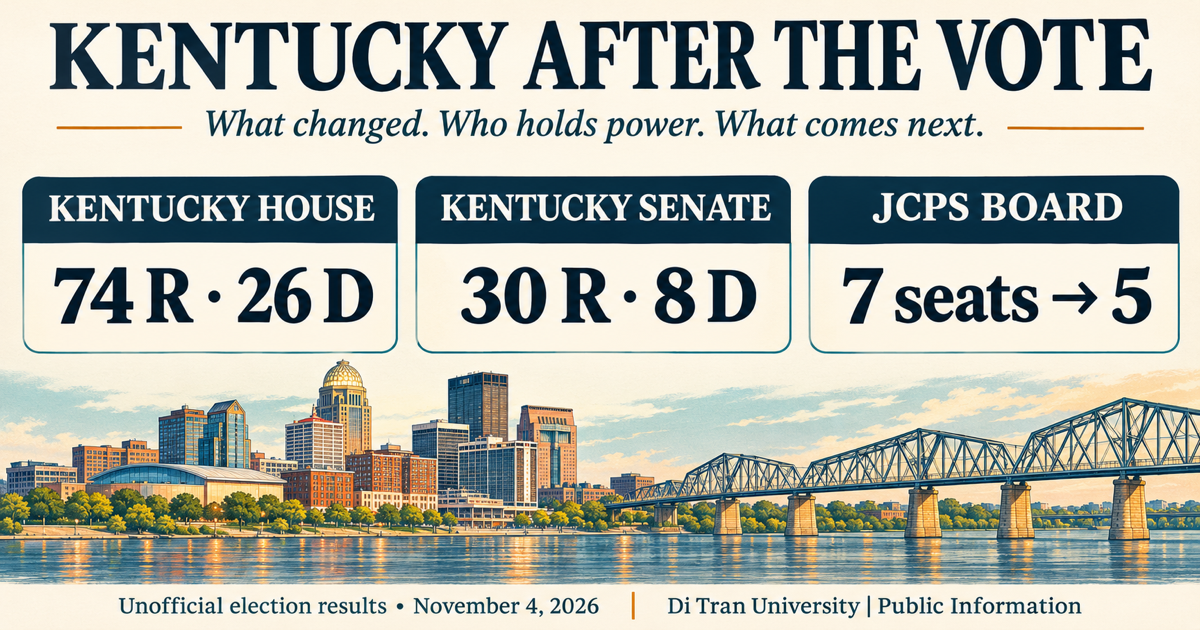
Kentucky After the Vote: unofficial November 4, 2026 results show Kentucky House 74 R and 26 D, Senate 30 R and 8 D; JCPS board changes from seven seats to five. Original Louisville editorial illustration.
The work continues after election night
From an operator’s perspective, an election changes the people we must understand and the decisions we must monitor. It does not replace our responsibility to serve learners, customers, patients, employees, or neighbors honestly.
My operating principle is simple: contribution first, evidence always. A business should be able to explain its costs, its obligations, its results, and its limits before asking government to change a rule. A school should not substitute a badge for student-value evidence. A pharmacy should not substitute a campaign promise for a current practice requirement.
These are editorial principles, not conclusions that one party or every incumbent has failed. Durable accountability includes the freedom to replace leaders and the freedom to retain effective ones. The goal is government that serves people lawfully and competently, not turnover for its own sake.
The result tables below provide the factual foundation for that discussion. Where the evidence is incomplete, the record says so. That is how we keep civic participation useful rather than theatrical.
Election results tell us who voters selected. They do not, by themselves, tell us which laws have changed. This report separates party flips, new officeholders, open seats, redrawn districts, and the actual authority each office holds.
Verification cutoff: November 04, 2026, 09:22 PM EST. Election: November 3, 2026. Kentucky reports 120 of 120 counties. Results remain unofficial. Other-state figures are dated reporting snapshots, not a certified canvass. R = Republican; D = Democratic; I = independent; L = Libertarian. “pp” means percentage points.
The balance of power at a glance
Body
Before election
Result at cutoff
Net / control
Kentucky U.S. House delegation
5 R / 1 D
4 R / 2 D
D +1; R −1; not nationwide control
Kentucky U.S. Senate delegation
2 R
2 R
No party change
Kentucky House
80 R / 20 D
74 R / 26 D
D +6; R −6; Republican supermajority remains
Kentucky Senate
32 R / 6 D
30 R / 8 D
D +2; R −2; Republican supermajority remains
Louisville Metro Council
13 D / 12 R / 1 I affiliations
No identified affiliation flip; three different officeholders
Net 0 by affiliation; no party alone has 14 seats. Leadership coalition not determined here.
JCPS board
7 members
5 elected seats; 2 returning, 3 new
Nonpartisan; no party-control calculation
Seven neighboring states — confirmed House flips
4 R-held seats and 1 D-held seat in confirmed subset
D gains IN-5, OH-7, MO-2, VA-2; R gains TN-9
Confirmed subset net D +3 / R −3; unresolved races excluded
Seven neighboring states — Senate
OH seat held R
OH elected D
D +1 / R −1; no other verified Senate flip in this scope
U.S. House nationwide
Republican-controlled outgoing House
Democratic majority projected by AP
Final seat count / net gain unresolved in this edition
U.S. Senate nationwide
Republican-controlled outgoing Senate
Democratic caucus majority projected by AP; at least 54 seats
Final party-versus-caucus tally and net gains not independently reconciled here
National control: AP national report. Kentucky contributed one net Democratic U.S. House gain and no Senate change. Kentucky plus the confirmed neighboring-state subset contributes net D +4 in the House and +1 in the Senate—not the nationwide net.
Unofficial results and board-size transition; JCPS is nonpartisan.
1. Kentucky federal offices: all seven races
Office / district
Winner / party
Defeated candidate(s) / party
Previous officeholder / party
Change
Votes and share of all votes
Winning margin
Status
Source
Senate
Andy BARR (R)
Charles BOOKER (D) Christopher CAMPBELL (affiliation not independently verified) Write-In (affiliation not verified / write-in)
Mitch McConnell (R)
Open-seat replacement; R hold
Andy BARR: 784,869 (54.99%) Charles BOOKER: 612,357 (42.90%) Christopher CAMPBELL: 29,892 (2.09%) Write-In: 152 (0.01%) Total: 1,427,270
Ned PILLERSDORF (D) Mikel WEIN (affiliation not independently verified) Gerardo SERRANO (affiliation not independently verified) Write-In (affiliation not verified / write-in)
Hal Rogers (R)
Incumbent retained
Hal ROGERS: 139,808 (71.16%) Ned PILLERSDORF: 49,805 (25.35%) Mikel WEIN: 4,117 (2.10%) Gerardo SERRANO: 2,738 (1.39%) Write-In: 6 (0.00%) Total: 196,474
Gallrein’s defeat of Massie occurred in May: AP/PBS primary report. Barr’s move to the Senate creates a new officeholder but not a Senate party flip.
2. Kentucky legislature: all 22 new officeholders
The tables identify 19 incoming House members and three incoming senators, not every incumbent who won reelection. General-election numbers are shown; a primary defeat is explicitly labeled and is not assigned November’s margin. Seven House seats moved R → D and one D → R: net D +6. Two Senate seats moved R → D. Robin Webb’s 2025 party switch is already in the pre-election baseline, not a 2026 election gain.
Office / district
Winner / party
Defeated candidate(s) / party
Previous officeholder / party
Change
Votes and share of all votes
Winning margin
Status
Source
House 14
Wes PATE (R)
Donna HAYNES (D)
Scott Lewis (R)
Open-seat replacement; R hold
Wes PATE: 10,236 (72.90%) Donna HAYNES: 3,806 (27.10%) Total: 14,042
3. Louisville Metro Council: all 13 contested-cycle seats
The 2026 ballot is nonpartisan. Affiliation labels below are separate from ballot labels. No affiliation flip was identified: ten incumbents returned, Barker defeated Purvis, and Dorsey and Brotzge-Elder won open seats. Dorsey previously served on council; “new” here means a change from the outgoing holder. McCraney’s independent status must not be silently counted as Democratic.
Strange and Everett return; Brents, Jackson and Killebrew join. Bass lost in District 4. The board reduction and redrawn districts mean other departures cannot all be called incumbent defeats. Senate Bill 4, enacted over veto April 14, 2026 is the controlling legislative record—not House Bill 4, as one news account stated.
The current JCPS roster lists temporary 2026 assignments: Tricia Lister (1), Corrie Shull (2), Taylor Everett (3), Trevin Bass (4), Gail Logan Strange (5), Linda Duncan and Keith Look (at large). These seven positions are not a one-to-one predecessor map for the five elected districts. The two returners and three new members form the five-seat incoming board; no partisan seat gain is calculated.
All five winners received the teachers-union-backed Better Schools Kentucky endorsement, according to LPM. That is an endorsement, not a party label.
5. Federal flips in Kentucky’s seven bordering states
Confirmed here means a located AP projection, concession, or clearly reported completed unofficial result—not certification. Official state portals were consulted first; several required JavaScript, returned access errors, or did not expose usable totals. Those limitations are not evidence that a race has no result. Secondary snapshots are explicitly identified and must not be combined with a different timestamp’s percentages.
Office / district
Winner / party
Defeated candidate(s) / party
Previous officeholder / party
Change
Votes and share of all votes
Winning margin
Status
Source
IN House 5
J.D. Ford (D)
Victoria Spartz (R)
Victoria Spartz (R)
R → D; incumbent defeated
J.D. Ford: 134,476 (51.66%) Victoria Spartz: 125,851 (48.34%) Total: 260,327
A party flip changes which party holds a seat. An incumbent defeat changes the person. An open-seat replacement fills a vacancy created by retirement or another departure. Redistricting changes who is represented. None is a substitute for studying the official’s actual votes, committee work, constituent service, and results.
Competitive elections allow voters to retain or replace leaders. That accountability matters more than treating turnover as automatically good or long service as automatically bad. A divided government can require negotiation; it can also produce deadlock. A unified government can act more quickly; it still needs oversight. Neither arrangement guarantees fair policy or competent administration.
The standard is service, rights, lawful process, and measurable public value—not team loyalty. People who build businesses, raise families, employ neighbors, or arrive here seeking opportunity deserve understandable institutions and equal treatment. This is civic information for all readers, not a recommendation to support a party or oppose a demographic or class of candidates. Claims that any nation is objectively “number one” or has the world’s “fairest” elections require a defined comparison; they are not findings of this report.
The three branches: different jobs, shared limits
Branch
Core responsibility
Important limit
Legislative — Congress
House and Senate consider laws, spending and oversight; Senate handles confirmation of covered presidential nominations
A House majority alone cannot enact a law; constitutional procedures and the other branches remain relevant
Executive — president and agencies
Administers and enforces laws within legal authority
A midterm congressional election does not elect a new president or automatically replace agency rules
Judicial — federal courts
Interprets and applies law in cases and decides constitutional questions
Judges do not replace elections or legislatures; court orders have defined scope
USAGov: branches and checks and balances. Parties are not branches. Federal, state, and local government are different levels of authority, not the three federal branches.
What this means for regulated businesses: analysis, not a prediction
For beauty schools, trade schools, pharmacies, and other small employers, the useful question is not “Who won our side?” It is “Which office controls the issue, what action has actually occurred, and when does it become effective?” Keep operating under current requirements until a controlling change is established.
Eligibility, disclosures, financing and accountability. Accreditation, state authorization and aid participation answer different questions; no election outcome proves educational value.
Licensing, practice rules, reimbursement and proposed legislation. Elections do not authorize scope expansion, product claims, or changed dispensing practices.
Distinguish proposals, enacted laws, binding rules and court orders. A candidate’s statement does not establish an individual’s status or a new employer duty.
Local budgets, ordinances, public meetings, school policy and implementation. Council and school board do not control federal immigration law or state professional licensure.
A practical 30-day owner checklist
Confirm the representatives for the business address and home address; redrawn boundaries may differ.
Maintain one dated register: proposal, enacted law, regulation, effective date, responsible agency, operational owner, and required action.
Monitor committee appointments and published agendas before assuming a winner controls a particular subject.
Document real implementation costs, student or patient impacts, and measurable service outcomes before offering policy feedback.
Use official constituent-service routes. Congratulations create no entitlement to funding, favorable regulation, access, endorsement, or special treatment.
Seek qualified advice for a concrete legal, tax, employment, education-finance, or pharmacy decision.
Our organizational responsibility is to make evidence easier to use: clear program choices, transparent prices, defined outcomes, respectful service, and accurate records. That standard remains the same regardless of which party holds office.
Method, conflicts and remaining gaps
Percentages for Kentucky and reconciled neighboring-state rows are calculated as candidate votes ÷ all listed votes, including minor-party and reported write-in votes. They may differ from the official display’s rounded whole percentages. Margins compare the two highest vote totals; unopposed races have no contested margin. “Complete” means reported counting completeness, not certification or the absence of later adjustments.
Remaining gaps: the final nationwide House/Senate seat counts and net gains, Virginia 2’s reconciled vote totals, unresolved neighboring-state contests, and some nonpartisan candidates’ affiliations. This is a substantial preliminary report, not a claim that every requested figure is final. Official certification, corrected totals or a reliable new call are the triggers for updating this same record.
About this public-information edition. Prepared for Di Tran University and related public-education channels at Di Tran’s request. Di is associated with Louisville Beauty Academy and other education and business organizations; that affiliation does not make this report a regulator’s statement. Direct sources. Clear status. Practical public information.
This is dated, source-linked general education, not individualized legal, financial, immigration, education, or healthcare advice. Citation does not imply endorsement, partnership, certification, or independent confirmation of every third-party assertion. Verify the controlling source, jurisdiction, effective date, and your own facts before acting, at your own discretion and risk. No candidate or party is endorsed. Corrections should update this edition rather than create a competing result.
Louisville brick storefront owner desk with separate invoice, payment receipt, and acceptance checklist
Direct sources. Clear status. Practical public information.
Reviewed November 4, 2026 · general U.S. small-business recordkeeping with a Louisville owner-use case.
Three records that should not merge
Record
Question answered
Boundary
Invoice
What did the seller or contractor bill, for what period and described scope?
Billing is not proof of payment, receipt, code approval, quality, or owner acceptance.
Proof of payment
What amount left which account, to which payee, on what date?
Payment does not automatically prove every item was delivered, accepted, or complete.
Owner acceptance
What did the responsible owner inspect and accept, subject to what exceptions?
Owner acceptance is an operating record; it does not replace permits, inspections, warranties, tax records, or professional review.
The IRS lists invoices, paid bills, receipts, account statements, canceled checks, and other proof of payment among business supporting documents. It also notes that a combination of documents may be needed to substantiate all elements of a purchase or expense. The owner-acceptance layer is this article’s operating synthesis—not an IRS-created legal form.
A seven-field closeout card
Legal parties, project or purchase, location, and period.
Invoice number, date, described scope, amount, taxes, credits, and change references.
Payment date, amount, account, payee, transaction reference, and reconciliation status.
Received deliverables and objective inspection or test evidence.
Owner acceptance date, responsible person, exceptions, and reserved issues.
Separate permit, regulator, warranty, lien, tax, insurance, or professional evidence when applicable.
Final stop point: do not call the matter closed while a material scope, safety, legal, payment, or acceptance question remains unresolved.
What the tool does not establish
It does not determine contract rights, tax treatment, permit status, workmanship, liability, warranty coverage, lien rights, or whether payment should be made. Those depend on the actual documents, facts, jurisdiction, responsible owner, and qualified review.
Sources reviewed November 4, 2026. Preserve private contracts, account data, and property details outside public copy.
Public-information notice: This Pulse is a dated, source-linked research summary for general educational use. It reports what the cited sources state or what the identified public record shows as of the date reviewed. Citation does not mean endorsement, partnership, certification, or independent confirmation of every third-party assertion. This is not individualized legal, medical, tax, accounting, investment, insurance, cybersecurity, licensing, regulatory, procurement, employment, real-estate, or other professional advice. Rules, facts, availability, and eligibility can change. Verify the controlling source, jurisdiction, effective date, and your own facts, and consult the responsible agency or a qualified professional before a consequential decision. External links are provided for attribution and may change. Use this information and any reader-controlled checklist at your own discretion and risk.
Louisville entrepreneur due-diligence room with separate seller claim source-document and professional-review layers
Direct sources. Clear status. Practical public information.
SBA’s public business-planning guidance tells prospective buyers to review contracts, leases, cash flow, inventory, licenses, permits, zoning, environmental issues, and valuation. Those are not one evidence class.
Three evidence states
State
Useful question
Limit
Seller claim
What exactly is being represented, for what period, entity, asset, customer, lease, employee group, or liability?
A statement is a lead; it is not the underlying record or independent verification.
Source document
Who issued it, is it complete, current, authentic, tied to the exact legal entity, and consistent with other records?
A document can be incomplete, stale, unaudited, amended, mis-scoped, or misunderstood.
Professional review
Which qualified reviewer examined which records, for what question, under what assumptions and limits?
A review in one discipline does not replace owner judgment or another required legal, tax, accounting, licensing, environmental, insurance, cybersecurity, or operational review.
The claim-to-proof handoff card
Claim: write the exact statement without promotional adjectives.
Owner and period: name the legal entity, asset, account, location, and date range.
Requested source: identify the record that would support or narrow the claim.
Received state: received, missing, incomplete, expired, conflicting, or inaccessible.
Reviewer: record the reviewer’s authority, scope, questions, and limitations.
Unresolved issue: keep unknowns visible; do not turn silence into a favorable answer.
Stop point: pause before deposit, signature, financing, public claim, staff/customer disclosure, or closing when a material record or human decision is missing.
What this method does not decide
It does not value a business, recommend a deal, verify a seller, or determine legal, tax, accounting, financing, zoning, environmental, employment, licensing, privacy, cybersecurity, or insurance consequences.
What Di Tran Enterprise can contribute
Di Tran Enterprise can teach a disciplined evidence-room method and preserve a no-action outcome as valid. It does not replace a qualified attorney, accountant, valuation professional, lender, regulator, insurer, inspector, or other responsible reviewer.
Sources reviewed November 3, 2026. The three-state taxonomy is an educational synthesis, not transaction advice.
Public-information notice: This Pulse is a dated, source-linked research summary for general educational use. It reports what the cited sources state or what the identified public record shows as of the date reviewed. Citation does not mean endorsement, partnership, certification, or independent confirmation of every third-party assertion. This is not individualized legal, medical, tax, accounting, investment, insurance, cybersecurity, licensing, regulatory, procurement, employment, real-estate, or other professional advice. Rules, facts, availability, and eligibility can change. Verify the controlling source, jurisdiction, effective date, and your own facts, and consult the responsible agency or a qualified professional before a consequential decision. External links are provided for attribution and may change. Use this information and any reader-controlled checklist at your own discretion and risk.
Louisville Business First published Di Tran’s guest viewpoint, “Louisville’s next workforce advantage is sitting in Newcomer classrooms,” in the Oct. 30–Nov. 5, 2026 print issue on page 31.
Thank you to Editor-in-Chief Shea Van Hoy and the Louisville Business First team for consistently making room for serious local ideas, practical debate, and the people working to strengthen our community. A strong local business publication does more than report transactions; it helps Louisville see its own capacity.
The central idea
Newcomer students are not a side program. They are part of Louisville’s future workforce, customer base, entrepreneurial community, and civic leadership. The published viewpoint argues that responsible AI may help multilingual students practice, translate, ask better questions, and turn knowledge into completed work—but only inside a model where teachers remain in authority, private student information stays protected, families receive clear notice and a meaningful non-AI option, and outcomes are measured before success is claimed.
What the article does—and does not say
It protects teachers: technology should increase skilled people’s reach, not become a pretext for removing them.
It proposes a bounded pilot: one transparent, district-approved learning lab with defined measures and human stop points.
It centers dignity: newcomer students are people with rights, talent, culture, and agency—not a labor supply to be extracted.
It rejects inflated claims: no promise that one person with AI replaces ten teachers, no guaranteed learning result, and no presumption of school approval.
A permanent record of gratitude
This page memorializes the publication and the contribution Louisville Business First makes when it elevates constructive community voices. The proper next step is not applause alone. It is disciplined implementation: define the owner, safeguard the people affected, measure what changes, publish the limits, and stop or revise when the evidence does not support expansion.
Louisville renovation project illustration with separate permit holder, inspector, and owner evidence lanes
Direct sources. Clear status. Practical public information.
Construction closeout becomes confusing when one person’s proof is used to answer another person’s question. Louisville Metro’s current inspection page separates at least three roles: the permit holder, the inspector/building official, and the property owner or contracting party.
Three roles, three evidence questions
Role
Primary question
Typical proof
Boundary
Permit holder
Has the required inspection been requested when the work is ready and accessible?
Permit number, approved plans at the job site, inspection request, appointment, and correction/reinspection history.
A request is not a pass; a permit holder’s statement is not the inspector’s result.
Inspector/building official
Does the inspected work comply with the applicable permit/code requirements at that stage?
Passed, Partial Pass, or Corrections Needed result; comments; follow-up inspection; permit-complete status; applicable Certificate of Occupancy or Letter of Acceptance.
An inspection does not settle every private scope, workmanship, warranty, invoice, lien, schedule, or payment issue.
Owner/contracting party
Was the agreed private scope delivered, documented, accepted, and financially closed?
Contract/scope, approved changes, invoices, payment receipts, warranties, manuals, lien releases when applicable, keys/access, and written acceptance/exception list.
Owner acceptance cannot replace a required public inspection or occupancy/acceptance document.
What Louisville’s official page currently establishes
The Office of Construction Review says the permit holder is responsible for requesting required inspections. It identifies common results as Passed, Partial Pass, and Corrections Needed. It also says follow-up inspections continue as needed until the work is Passed, and that a project is complete when all inspections are passed and the permit status is marked complete, followed by the applicable Certificate of Occupancy or Letter of Acceptance.
A reusable closeout index
Public identity: permit number, address, work type, permit holder, and current public status.
Approved baseline: plans, scope, listed contractors, and permitted work.
Changes: who requested each change; whether the inspector required revised drawings or permit revision; who approved private price/time changes.
Inspection evidence: each stage, date, result, comment, reinspection, and final status.
Occupancy/acceptance record: exact document, issuer, date, scope, and limitations.
Stop rule: do not merge “passed,” “paid,” and “accepted.” Pause when any required public or private record is missing or inconsistent.
What this article does not decide
It does not determine whether a particular project is code-compliant, contract-complete, safely occupiable, lien-free, warranted, or fully paid. The permit, approved plans, inspection records, governing code, contract, and qualified professional review may all matter.
What Di Tran Enterprise can contribute
Di Tran Enterprise can teach owners to preserve a two-layer closeout file: public permit/inspection proof and private contract/acceptance proof. It does not act as the building official, attorney, engineer, inspector, title professional, contractor, or insurer.
Official pages were indexed as current on November 2, 2026; direct command-line retrieval returned an access-policy response. Verify the live pages and exact project record before acting.
Public-information notice: This Pulse is a dated, source-linked research summary for general educational use. It reports what the cited sources state or what the identified public record shows as of the date reviewed. Citation does not mean endorsement, partnership, certification, or independent confirmation of every third-party assertion. This is not individualized legal, medical, tax, accounting, investment, insurance, cybersecurity, licensing, regulatory, procurement, employment, real-estate, or other professional advice. Rules, facts, availability, and eligibility can change. Verify the controlling source, jurisdiction, effective date, and your own facts, and consult the responsible agency or a qualified professional before a consequential decision. External links are provided for attribution and may change. Use this information and any reader-controlled checklist at your own discretion and risk.
Louisville building closeout illustration with four separate checkpoints for inspection, permit, occupancy, and owner acceptance
Direct sources. Clear status. Practical public information.
A building project can have a passed inspection without proving that every closeout layer is finished. Louisville Metro’s public Construction Review guidance explains that a project is complete when required inspections have passed and the permit is marked complete; a Certificate of Occupancy or Letter of Acceptance then documents the applicable occupancy/use result. Contract acceptance, final payment, warranties, and owner records remain separate questions.
Four signals—four questions
Signal
Question it answers
What it does not prove by itself
Required inspection passed
Did the identified inspection receive a passing result?
That every inspection, permit, scope item, payment, warranty, or owner condition is complete.
Permit marked complete
Did the permit record reach the jurisdiction’s completion state?
That private contract obligations or latent-defect questions are resolved.
Certificate of Occupancy (when applicable)
What occupancy/use approval did the authority issue?
Ownership, workmanship quality, final payment, or warranty performance.
Letter of Acceptance (when applicable)
What acceptance document did Construction Review issue for the applicable project?
Private owner acceptance of every deliverable or release of every claim.
The owner’s closeout crosswalk
Permit record: number, address kept private where appropriate, scope, responsible permit holder, status, and current official source.
Inspection chain: required inspection types, dates, results, correction notices, and final passing evidence.
Jurisdiction closeout: permit-complete state and the applicable CO or Letter of Acceptance.
Contract closeout: scope completion, change orders, punch list, acceptance criteria, lien/waiver review, final invoice, payment state, and disputes—each separately controlled.
Stop rule: do not collapse a public permit status into private contract completion or a private payment into public occupancy authority.
What changed in this edition
This edition adds a four-signal closeout map and a six-part owner crosswalk. It does not evaluate a particular property, contractor, permit, inspection, payment, warranty, or dispute.
Human stop point
Pause when required inspections, permit status, change of use, occupancy classification, authorized closeout document, contract acceptance, payment, lien rights, warranty, or responsible signer is uncertain. Confirm with Louisville Metro Construction Review and qualified construction, legal, insurance, engineering, or accounting professionals for the actual project.
What DiTran.net can contribute
DiTran.net can provide an owner-controlled evidence crosswalk that keeps public authority, inspection, contract, payment, and warranty records separate. It does not inspect property, approve occupancy, certify work, resolve a dispute, or give individualized legal or construction advice.
Jurisdiction: Louisville/Jefferson County, Kentucky. Official pages observed November 1, 2026. Applicability depends on the actual permit, occupancy, use, and project facts.
Public-information notice: This Pulse is a dated, source-linked research summary for general educational use. It reports what the cited sources state or what the identified public record shows as of the date reviewed. Citation does not mean endorsement, partnership, certification, or independent confirmation of every third-party assertion. This is not individualized legal, medical, tax, accounting, investment, insurance, cybersecurity, licensing, regulatory, procurement, employment, real-estate, or other professional advice. Rules, facts, availability, and eligibility can change. Verify the controlling source, jurisdiction, effective date, and your own facts, and consult the responsible agency or a qualified professional before a consequential decision. External links are provided for attribution and may change. Use this information and any reader-controlled checklist at your own discretion and risk.