Direct sources. Clear status. Practical public information.
A document can be present in a business-purchase data room and still be stale, incomplete, inconsistent, or outside the reviewer’s authority. The U.S. Small Business Administration tells prospective buyers to conduct due diligence, review the full landscape, ask about contracts, leases, cash flow, and inventory, and consider qualified attorney and accountant help.
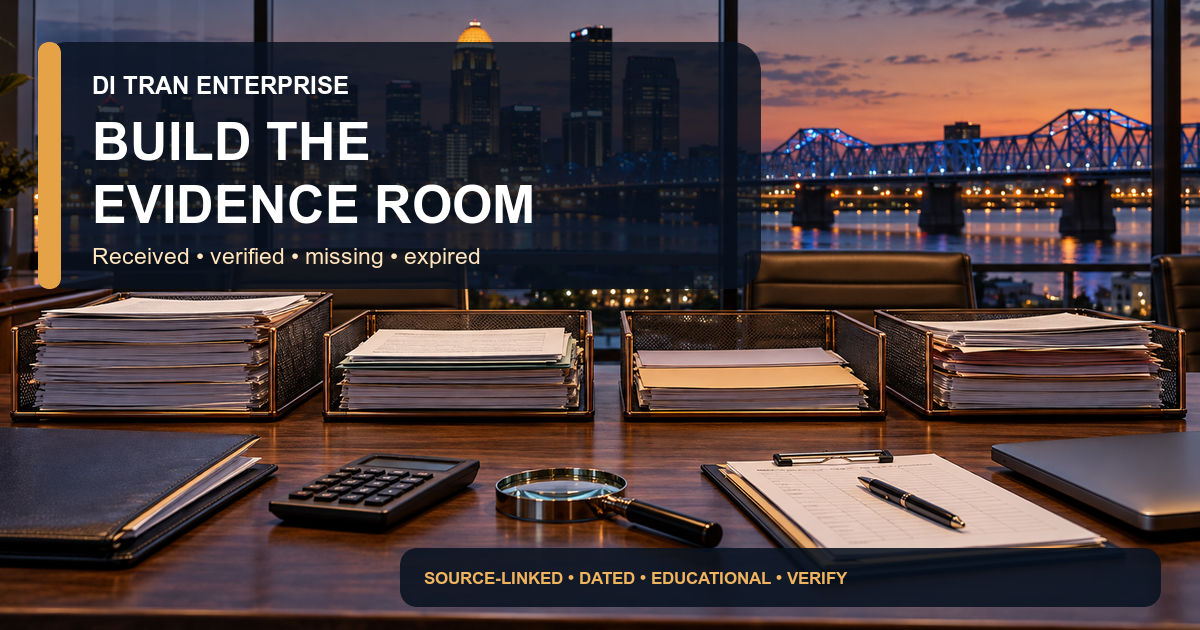
The practical upgrade is to give every material item an evidence state. Received is not the same as verified.
The four evidence states
| State | Meaning | Minimum record | Do not call it |
|---|---|---|---|
| Received | The buyer’s controlled file route contains the item. | File name, source, received date, stated period, version, and custodian. | Authentic, complete, current, accurate, or accepted. |
| Verified | The responsible reviewer completed the bounded check assigned to that item. | Reviewer, authority, method, date, result, limits, unresolved questions, and evidence pointer. | Universal truth, future performance, legal approval, or deal recommendation. |
| Missing | A needed item or field was not located in the checked route by the cutoff. | Exact request, date, scope checked, responsible owner, and next trigger. | Proof that the record does not exist or that anyone acted improperly. |
| Expired | The item no longer covers the decision period or requires current confirmation. | Issue/effective/expiration date, current-source route, and replacement request. | Current authority, current price, current insurance, current license, or current performance. |
The evidence-room index
Use one row for each material item:
- Item key: category + issuer/source + date/period + version.
- Claim supported: the exact question the item may answer.
- Source and custody: who supplied it and where the controlled copy is stored.
- State: received, verified, missing, expired, disputed, superseded, or not applicable.
- Reviewer and authority: owner, attorney, accountant, lender, insurer, regulator, or specialist—kept separate.
- Limit: what the item does not establish.
- Next action: request, reconcile, independently confirm, professionally review, replace, or hold.
- Stop point: the condition that prevents price, financing, signature, payment, possession, or closing.
Example categories to index
| Category | Examples | Typical human gate |
|---|---|---|
| Identity and authority | Seller entity, ownership/authority evidence, asset or equity scope, assumed names. | Attorney and controlling registry. |
| Financial and tax | Statements, tax returns, bank/sales records, payroll, liabilities, working capital, inventory. | Qualified accountant/financial reviewer. |
| Contracts and property | Leases, licenses, permits, customer/vendor agreements, financing, liens, claims, change-of-control terms. | Attorney plus responsible authority. |
| Operations and people | Staffing, processes, equipment, subscriptions, cybersecurity, vendor/customer concentration, transition plan. | Owner/operator and relevant specialist. |
| Risk and insurance | Policies, loss history when lawfully available, required coverages, exclusions, renewal conditions. | Licensed insurance professional and attorney when needed. |
A safe AI use
AI can help build a blank index, normalize file names, identify missing fields, or draft reviewer questions using sanitized information. Do not upload confidential agreements, tax returns, bank records, employee or customer data, credentials, private communications, or deal terms to a public AI service. AI does not authenticate documents or replace the responsible reviewer.
Reader stop point
Stop before advancing a consequential term when a material record is missing, expired, contradictory, outside the reviewer’s authority, or tied to an unresolved consent, privacy, financing, licensing, insurance, tax, or legal issue. A clean folder is not a clean deal.
What Di Tran Enterprise can contribute
Di Tran Enterprise can contribute a disciplined evidence-room index, a no-duplicate request log, and owner-side stop points. It does not certify a seller, valuation, document, license, income, financing, insurance, legal result, tax result, profitability, or transaction outcome.
Official source
Scope: general business-purchase education. SBA source observed October 29, 2026. The actual transaction, jurisdiction, documents, and qualified review control.
Public-information notice: This Pulse is a dated, source-linked research summary for general educational use. It reports what the cited sources state or what the identified public record shows as of the date reviewed. Citation does not mean endorsement, partnership, certification, or independent confirmation of every third-party assertion. This is not individualized legal, medical, tax, accounting, investment, insurance, cybersecurity, licensing, regulatory, procurement, employment, real-estate, or other professional advice. Rules, facts, availability, and eligibility can change. Verify the controlling source, jurisdiction, effective date, and your own facts, and consult the responsible agency or a qualified professional before a consequential decision. External links are provided for attribution and may change. Use this information and any reader-controlled checklist at your own discretion and risk.