Categories
Property & Construction

Permit Issued Is Not Project Complete: A Louisville Construction Status Ladder

A permit being issued is an important milestone. It is not proof that the work is complete, that every inspection passed, or that the space is approved for occupancy. Property owners lose clarity when application, approval, construction, inspection, correction, and closeout are treated as one status.

Louisville Metro’s Construction Review pages describe an inspection process in which the permit holder requests required inspections and inspection outcomes may include Passed, Partial Pass, or Corrections Needed. The city also states that required inspections must be completed before a Certificate of Occupancy or Letter of Acceptance is issued. Those are separate checkpoints.

The seven-state construction ladder

State What it means Evidence to preserve
1. Application submitted A request is in the review system Application or project number, scope, date, responsible contact
2. Permit issued Authorized work may proceed within the permit’s scope and conditions Issued permit, approved plans, conditions, expiration information
3. Work underway Construction activity is occurring Dated progress record, approved changes, contractor and trade responsibility
4. Inspection requested A required checkpoint has been scheduled or requested Inspection type, request date, confirmation, site-readiness note
5. Result recorded The inspector records Passed, Partial Pass, or Corrections Needed Official result and exact correction items
6. Corrections closed Required items are completed and reinspection evidence is resolved Correction log, reinspection request, final result
7. Final closeout Required inspections are complete and the applicable occupancy or acceptance document is issued Certificate of Occupancy, Letter of Acceptance, or other controlling closeout record

Why ‘partial pass’ needs its own row

A partial pass is not the same as a failed project, but it is also not the same as final completion. Treat it as a bounded worklist:

  1. Copy the official inspection result exactly.
  2. Assign each open item to the responsible trade or owner.
  3. Record the evidence needed to show correction.
  4. Identify who may request the next inspection.
  5. Do not advance the internal project status until the receiving surface shows the next verified state.

A one-page owner control

For each permit, keep one current row with:

Permit number → approved scope → holder → current state → last official result → open corrections → next inspection → closeout document → checked on

This protects everyone from a common communication failure: one person says ‘approved’ meaning permit issued, another means an inspection passed, and a third means the entire project is ready for occupancy.

Stop points

  • Do not describe a permit as proof that uninspected work is complete.
  • Do not describe construction photos or a contractor statement as an official inspection result.
  • Do not treat a partial pass as final closeout.
  • Do not occupy or open a space based on an assumed approval; verify the controlling occupancy or acceptance requirement for the project.
  • If the scope, inspection sequence, or closeout document is unclear, pause and contact Louisville Metro Construction Review or the appropriate qualified professional.

What Di Tran Enterprise contributes

Di Tran Enterprise can help owners turn scattered project updates into a disciplined status record: one state, one evidence pointer, one responsible owner, and one next trigger. The value is clearer project control—not a substitution for city authority, licensed design, trade responsibility, or legal advice.

Official sources

Sources reviewed October 24, 2026. This is general public education, not legal, code, engineering, architectural, or project-specific advice. Requirements vary by scope; verify the live official record for the exact permit.
Categories
Property Operations

Call 811 Before You Dig: The Kentucky Owner’s Stop-Point Checklist

A shovel, post-hole digger, trencher, or excavator can turn a small property project into a dangerous service interruption. Kentucky 811’s current guidance says everyone who digs must contact 811 before breaking ground, and Kentucky law requires at least two full working days before excavation begins.

The operational lesson is broader than “make one call.” A responsible owner creates a short evidence chain: define the work, submit the request, wait, confirm every response, inspect the markings, identify what may not be covered, and stop when the record is incomplete.

The seven owner stop points

  1. Scope before ticket: identify the exact address, excavation area, method, depth, start date, and responsible person. Mark the proposed area with white paint or flags when appropriate.
  2. Ticket before work: submit the locate request through the current Kentucky 811 route and keep the confirmation or ticket number.
  3. Two full working days: do not convert “some utilities responded” into permission to start. Kentucky 811 says to allow at least two full working days.
  4. Positive response check: verify each notified utility’s status—marked, clear/no conflict, delayed, or needing more information. One missing response is a stop point.
  5. Field-to-record match: compare the ticket responses with the paint, flags, and stakes actually present. Markings show an approximate location, not a guarantee of exact depth or position.
  6. Private-utility gap: Kentucky 811 says lines beyond a meter, pedestal, or primary service point may be privately owned and may not be included in a standard request. Irrigation, lighting, outbuildings, generators, private gas, or other property-side lines may require separate locating.
  7. Protect and renew: preserve markings. If they fade, become unclear, the area changes, or the ticket period expires, stop and obtain the appropriate update before continuing.

A one-page owner record

Field Record
Project Work area, method, depth, responsible person
Locate request Ticket number, submitted date/time, planned dig date
Responses Each utility/operator and exact status
Field proof Dated photos of markings and work boundary
Coverage gaps Non-member or private lines requiring another route
Stop/restart Reason work stopped and proof required to restart

What 811 does not prove

A completed ticket does not prove every underground line is public, marked, at a known depth, or safe to cross mechanically. It does not replace permits, easements, utility approvals, contractor competence, safety rules, or a property-specific professional review. If markings or responses conflict, do not guess.

The owner’s standard is not speed. It is safe, documented restart authority: no ground disturbance until the planned area, required waiting period, positive responses, field markings, private-line questions, and current ticket state all support proceeding.

Official sources

Source review: October 23, 2026. This is general safety and project-control education, not legal, engineering, utility, construction, or excavation advice. Use the current ticket, utility, permit, and qualified-professional requirements for the actual project.

Categories
Real Estate Operations

Before You Break Ground in Louisville: The MSD Approval Stack Owners Must Map

A construction schedule can look simple until one unresolved public-infrastructure question stops the next trade. In Louisville, land disturbance, drainage, sanitary-sewer service, floodplain, easements, and other-agency approvals can form a connected approval stack.

This is a general owner’s planning map derived from current Louisville MSD sources. It does not evaluate any private property or replace project-specific engineering, legal, code, zoning, plumbing, or environmental review.

The seven-layer approval stack

1. Define the disturbance and project category

MSD says its development review covers land-disturbing activity in Jefferson County and sanitary-sewer extensions within its service area. The current permitting page distinguishes single-family/demolition/small commercial, small site disturbance, and large site disturbance. MSD states that land disturbance above 2,000 square feet requires a Site Disturbance Permit, with additional requirements above one acre.

2. Map drainage before design hardens

Development review may analyze drainage adjacent to and downstream of a project, grading, erosion prevention and sediment control, water quality, and floodplain issues. A site plan that ignores downstream or watershed constraints can create redesign risk later.

3. Verify sanitary-sewer service and downstream capacity

MSD’s small-project guidance says Customer Service can help determine whether a property service connection is available and whether required impact fees were paid. New connections require a Downstream Facilities Capacity request. A visible sewer structure or a contractor assumption is not the same as capacity approval.

4. Resolve easements and encroachments

MSD publishes separate easement, right-of-way, release, and encroachment procedures. Corporate or partnership owners may need a notarized corporate resolution; LLCs may need to provide an operating agreement for certain easement or encroachment plats. Ownership authority and survey documentation should be planned early.

5. Check floodplain and outside-agency gates

MSD states that floodplain development may require both Kentucky Division of Water and local MSD permits. Depending on the project, approvals may also involve Louisville Metro, Public Health and Wellness, Kentucky Transportation Cabinet, the U.S. Army Corps of Engineers, or other jurisdictions.

6. Price the written fees—not just construction labor

The current FY2027 rate schedule includes connection, capacity, drainage, inflow-and-infiltration, system-development, inspection/location, and other potential charges. Which charges apply is property- and project-specific. Obtain written, dated determinations instead of carrying an unsupported allowance.

7. Define release and closeout evidence

For sanitary-sewer extensions, MSD’s published process includes capacity approval, design approval, permits/contracts, construction, inspection, as-built information, possible charges, and final release items. “Installed” and “released for connection” are different states.

The owner’s one-page control sheet

  • Project scope and square feet of disturbance
  • Parcel, zoning/use, and jurisdiction
  • Drainage and floodplain layers checked
  • Property service connection evidence
  • Downstream-capacity request and response
  • Easements/right-of-way/encroachment status
  • Required agencies and named decision owner
  • Applications, fees, bonds, and payment proof
  • Inspection sequence and release criteria
  • Open unknown, owner, deadline, and next trigger

Why this reduces stress

Stress grows when multiple authorities, technical terms, and deadlines are compressed into one vague word—“permit.” The antidote is a state map: requested, under review, approved with conditions, paid, inspected, accepted, and released. Each state needs its own proof.

Good ownership means protecting people, time, money, and relationships with a record that shows what is known, what remains unknown, and who controls the next decision.

Official sources

Source review: October 22, 2026. Recheck current forms, fees, design standards, and agency requirements for each project.

Categories
Business Operations

Budget Is Not Approval: The Operator’s Change-Control Rule for Construction and Vendor Work

A budget answers, “What capacity may exist?” Approval answers, “What exact work did an authorized person agree to?” Confusing the two is one of the fastest ways to damage a project, a vendor relationship, and the truth of the ledger.

This distinction matters in construction, technology, marketing, equipment repair, professional services, and almost every project where real conditions can change. A contingency, allowance, reserve, or unspent budget is not automatically money owed. It is controlled capacity that may support a documented decision.

The operator’s rule

No extra work should become an approved extra merely because it seems useful, the budget can absorb it, or someone already started. Before work begins—except for minimum emergency stabilization—reconcile eight things in writing:

  1. Trigger: What new condition, owner request, code issue, design conflict, or discovery caused the proposed change?
  2. Original scope: What did the signed agreement already include?
  3. Evidence: What photos, measurements, inspection notes, drawings, or records show the condition?
  4. Revised scope: What exact labor, material, equipment, subcontractor work, and result are now proposed?
  5. Credits: What original work, allowance, material, or labor will no longer be required?
  6. Price: What are the quantities, rates, markup, taxes, and not-to-exceed total?
  7. Time: What changes in schedule, access, inspection, occupancy, or downstream work?
  8. Authority: Who may approve it, and where is the dated written approval?

A strong change record makes it possible to say yes quickly when the evidence is complete. It also makes a respectful no—or a request for missing information—less personal.

Why written scope protects both sides

The U.S. Small Business Administration’s government-contracting guidance illustrates a broader operating principle: specifications matter, inspections test the promised result, changes can affect price and schedule, and the contract governs how disagreements are handled. Private contracts differ, but the discipline of identifying the change and its consequences remains valuable.

Written control protects the owner from surprise charges and duplicate scope. It protects the vendor from doing requested work and later facing a memory dispute. It protects the project team from using the same contingency twice. Most importantly, it creates a record that a future reviewer can understand without reconstructing the story from text messages.

The three-ledger method

Keep three numbers visibly separate:

  • Base contract: the approved original scope and price.
  • Approved changes: executed changes that modify scope, price, or time.
  • Unapproved requests: proposed or disputed items still awaiting evidence and authority.

Do not add an unapproved request to the amount due. Do not erase it either. Hold it with a clear status and next requirement.

Payment proof is not scope proof

The IRS explains that business records may need supporting documents such as invoices, receipts, paid bills, deposit records, and canceled checks. Those records can prove that money moved. They do not by themselves prove that a new scope was approved, that the work was complete, or that a charge was not already included elsewhere.

For each payment, preserve the payee, date, amount, project, approved scope reference, milestone, proof of receipt, and remaining balance. Keep proposed, approved, invoiced, paid, and finally accepted amounts separate.

A one-page change-control template

Change title and date
Condition or request that triggered the change
Original contract section and included allowance
Evidence reviewed
Revised work and exclusions
Deleted-work or allowance credits
Itemized price and not-to-exceed total
Schedule and inspection effect
Minimum emergency stabilization, if any
Approval authority, signature/date, and stop point

If a true emergency threatens people, property, or an active system, authorize only the minimum stabilization that the contract and circumstances permit. Document the condition immediately. Stabilization is not blanket approval for the entire permanent repair or any later price.

A hypothetical example

A project has a $15,000 contingency. A vendor discovers a condition and proposes $9,000 of additional work. The existence of the contingency does not approve the $9,000. The team still needs to determine what the base scope included, which work is genuinely additional, what original work should be credited, what evidence supports the quantities and price, who has authority, and what happens to the schedule.

If the validated net change is $4,500 and the authorized owner approves it in writing, then—and only then—does the approved-change ledger rise by $4,500. The remaining contingency is a separate management figure, not an invitation to spend.

Operator dignity

Good control is not hostility. It is respect made visible: respect for the owner’s money, the vendor’s labor, the project’s quality, and the future relationship. The best system makes accurate work easier to approve and incomplete work easier to repair.

Sources

This is an operational education framework, not legal, accounting, tax, engineering, architectural, construction-management, or contract advice. The signed agreement, applicable law, licensed professionals, insurers, lenders, and counsel may control a specific project.

Categories
Education

Shape Selection: Public Access and Beauty Workforce Dignity

Strategic Companion Note – Day 39. This companion article explains the doctrine behind Louisville Beauty Academy’s public-service nail education model. It is not a duplicate of the LBA service-literacy post; it is the research and humanization frame behind it.

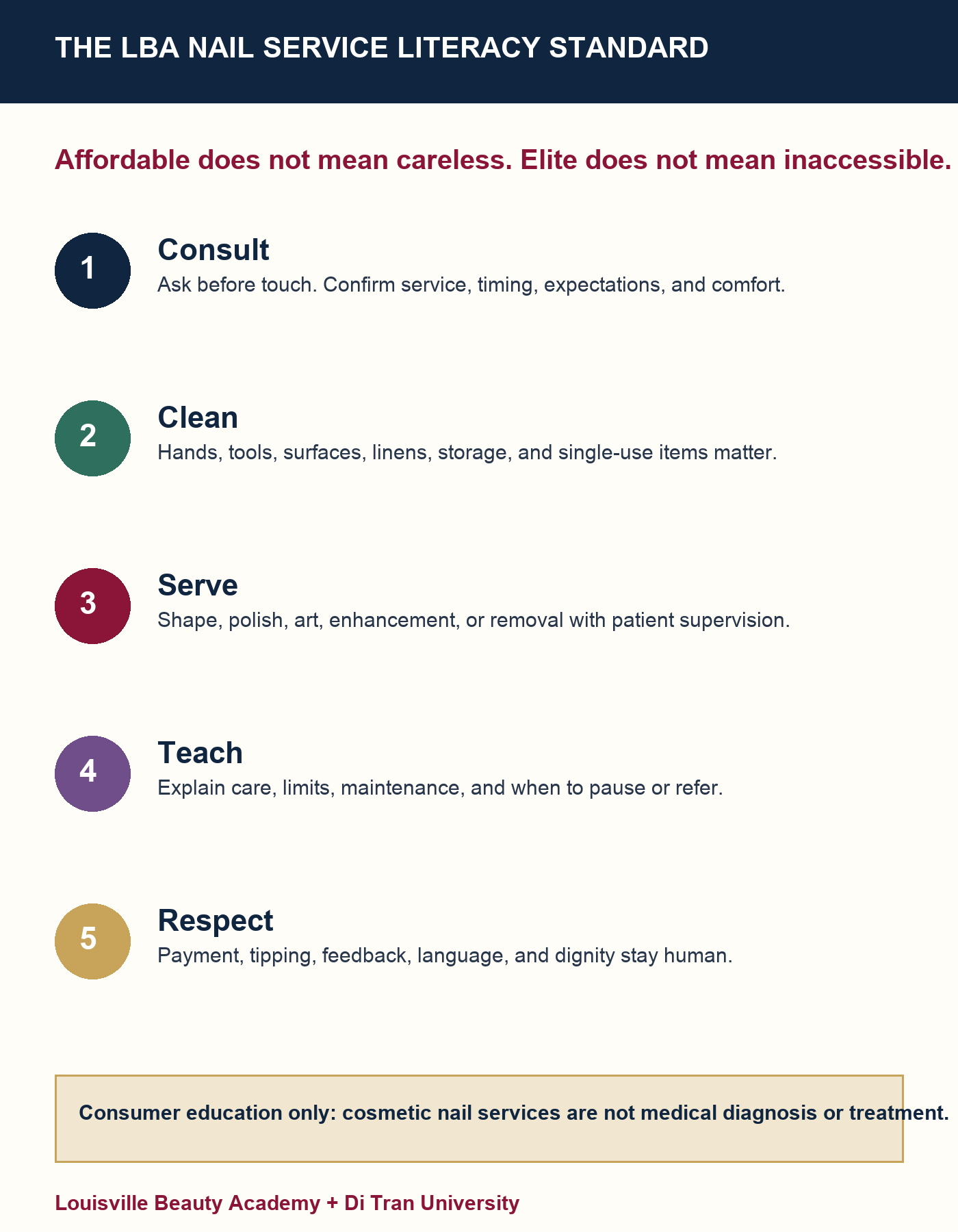
Infographic showing the LBA nail service literacy standard: consult, clean, serve, teach, and respect
Affordable nail-service literacy as public access and workforce dignity.

Shape Selection: The Doctrine Behind Accessible Beauty

Square, round, almond, and practical decision-making. Di Tran University reads this as a workforce and humanization question. When a service is affordable, supervised, clean, and clearly explained, it teaches more than technique. It teaches that professional standards can serve ordinary people without becoming ordinary in quality.

The Framework

  • Human dignity: beauty service is a human interaction before it is a transaction.
  • Workforce learning: repetition, consultation, sanitation, and timing become employable habits.
  • Affordability ethics: lower cost should not mean lower care, weaker documents, or vague promises.
  • AI-enabled support: AI can help organize education, documentation, translation, and publishing, while human supervision and licensing boundaries remain central.

Research-Supported Boundaries

Official labor and occupational sources describe manicurists and pedicurists as workers who clean, shape, polish, decorate, and care for fingernails and toenails. Public safety sources also remind the industry that product directions, chemical awareness, sanitation, ventilation, and referral boundaries matter. The doctrine is simple: teach the service, teach the limit, and never let marketing outrun proof.

Sources

Educational notice: this companion article does not make medical, legal, employment, licensure, pricing, or government-endorsement claims. Current school documents and official public sources control.

Categories
Education

Luxury Standard Without Luxury Exclusion: Public Access and Beauty Workforce Dignity

Strategic Companion Note – Day 29. This companion article explains the doctrine behind Louisville Beauty Academy’s public-service nail education model. It is not a duplicate of the LBA service-literacy post; it is the research and humanization frame behind it.

Infographic showing the LBA nail service literacy standard: consult, clean, serve, teach, and respect
Affordable nail-service literacy as public access and workforce dignity.

Luxury Standard Without Luxury Exclusion: The Doctrine Behind Accessible Beauty

The core LBA doctrine: premium standards can belong to everybody, not only luxury-price consumers. Di Tran University reads this as a workforce and humanization question. When a service is affordable, supervised, clean, and clearly explained, it teaches more than technique. It teaches that professional standards can serve ordinary people without becoming ordinary in quality.

The Framework

  • Human dignity: beauty service is a human interaction before it is a transaction.
  • Workforce learning: repetition, consultation, sanitation, and timing become employable habits.
  • Affordability ethics: lower cost should not mean lower care, weaker documents, or vague promises.
  • AI-enabled support: AI can help organize education, documentation, translation, and publishing, while human supervision and licensing boundaries remain central.

Research-Supported Boundaries

Official labor and occupational sources describe manicurists and pedicurists as workers who clean, shape, polish, decorate, and care for fingernails and toenails. Public safety sources also remind the industry that product directions, chemical awareness, sanitation, ventilation, and referral boundaries matter. The doctrine is simple: teach the service, teach the limit, and never let marketing outrun proof.

Sources

Educational notice: this companion article does not make medical, legal, employment, licensure, pricing, or government-endorsement claims. Current school documents and official public sources control.

Categories
Public Service

A Kentucky Senate Recognition For A Human-Centered Workforce Mission

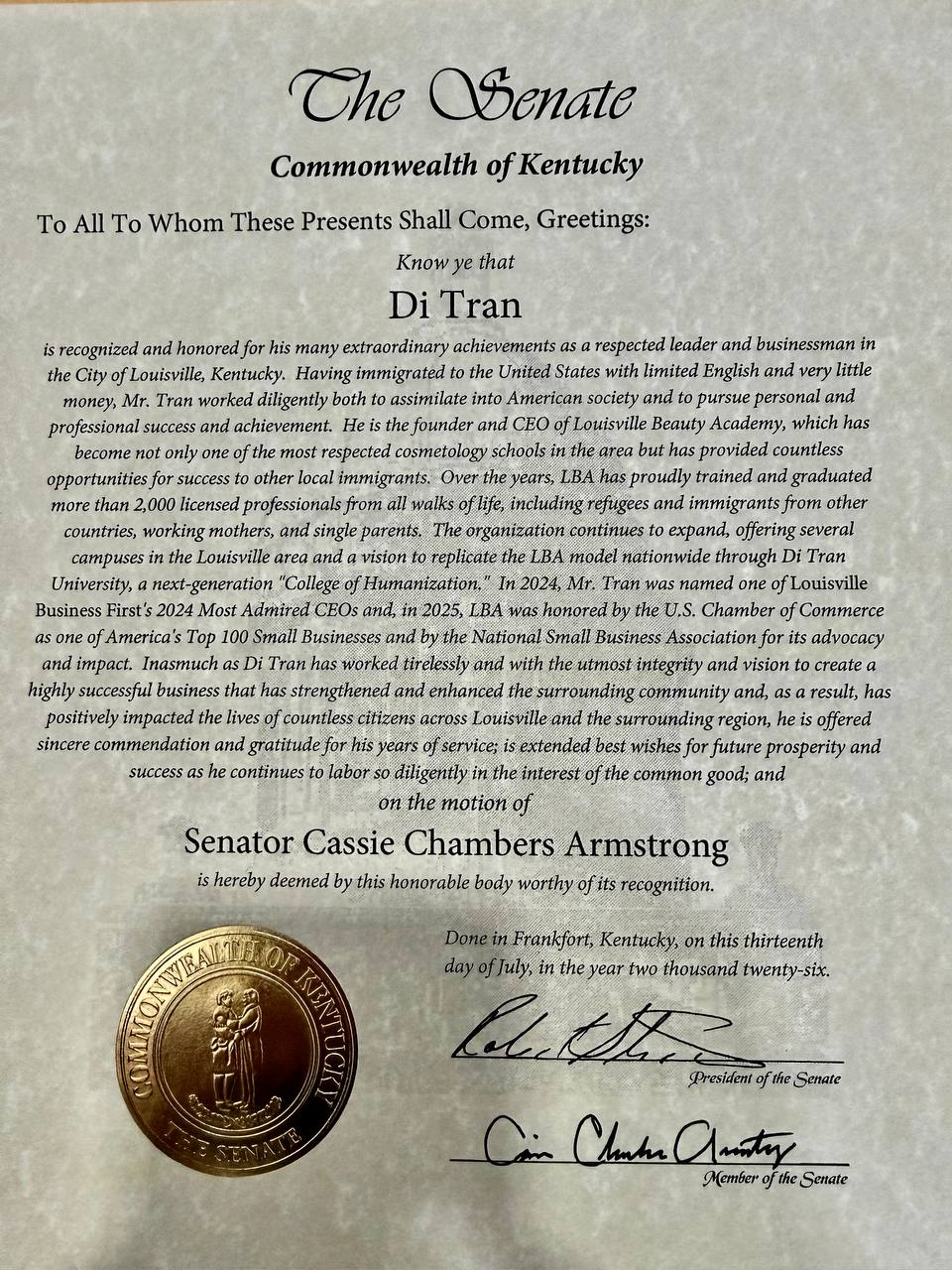
The Kentucky Senate recognition of Di Tran is a marker in a longer institutional journey. It ties together immigrant life, human-centered AI, workforce education, beauty licensure, small-business service, and the mission to build a College of Humanization through proof, discipline, and public value.

A Kentucky Senate recognition dated July 13, 2026 now becomes part of the public record of a larger story: immigrant entrepreneurship, licensed beauty education, nail-industry workforce modernization, and public service rooted on Bardstown Road in Louisville.

Why This Matters

This recognition is not merely a ceremonial certificate. It connects a state-level public honor with the real workforce environment of Louisville Beauty Academy, where adult learners, immigrants, working families, and future licensed beauty professionals train for lawful work, small-business ownership, and community service.

The Visit Before The Recognition

On Friday, June 26, 2026, Senator Cassie Chambers Armstrong visited Louisville Beauty Academy at 10:00 AM and spent nearly an hour with the school. The visit included the school environment, the student-centered workforce model, responsible AI-supported documentation, and beauty-policy topics connected to licensing, public protection, nail technology demand, and practical opportunity.

The Senate Recognition

The Kentucky Senate recognition honors Di Tran as founder and CEO of Louisville Beauty Academy, recognizes the academy’s service to more than 2,000 licensed professionals, and notes LBA’s 2025 recognition by the U.S. Chamber of Commerce as one of America’s Top 100 Small Businesses. The recognition was made on the motion of Senator Cassie Chambers Armstrong and dated July 13, 2026 in Frankfort, Kentucky.

Senator Armstrong’s Public-Service Credentials

Official public records identify Senator Cassie Chambers Armstrong as Kentucky Senate District 19, Minority Whip, and a member of the Senate Licensing and Occupations Committee. Her official biography also identifies her as an Assistant Professor of Law at the University of Louisville Brandeis School of Law, with degrees from Yale University, the Yale School of Public Health, the London School of Economics, and Harvard Law School. Her public work brings together law, public policy, access to justice, local government, and state legislative service.

SB14 and Nail-Industry Modernization

Senate Bill 14 from the 2024 Kentucky Regular Session was an act relating to beauty services. The official record states that the enacted version amended Kentucky beauty law to add a licensed nail technician to the Board of Cosmetology, replace one citizen-at-large board position with a licensed esthetician, and allow cosmetologists and nail technicians to use callus graters for callus removal. The bill passed the Senate 37-0, passed the House 92-0, and was signed by the Governor as Acts Chapter 25.

For public accuracy, Senator Armstrong should be described as having supported and voted for SB14. Sponsor credit should follow the official bill record, which lists Senator Reginald Thomas and the named co-sponsors.

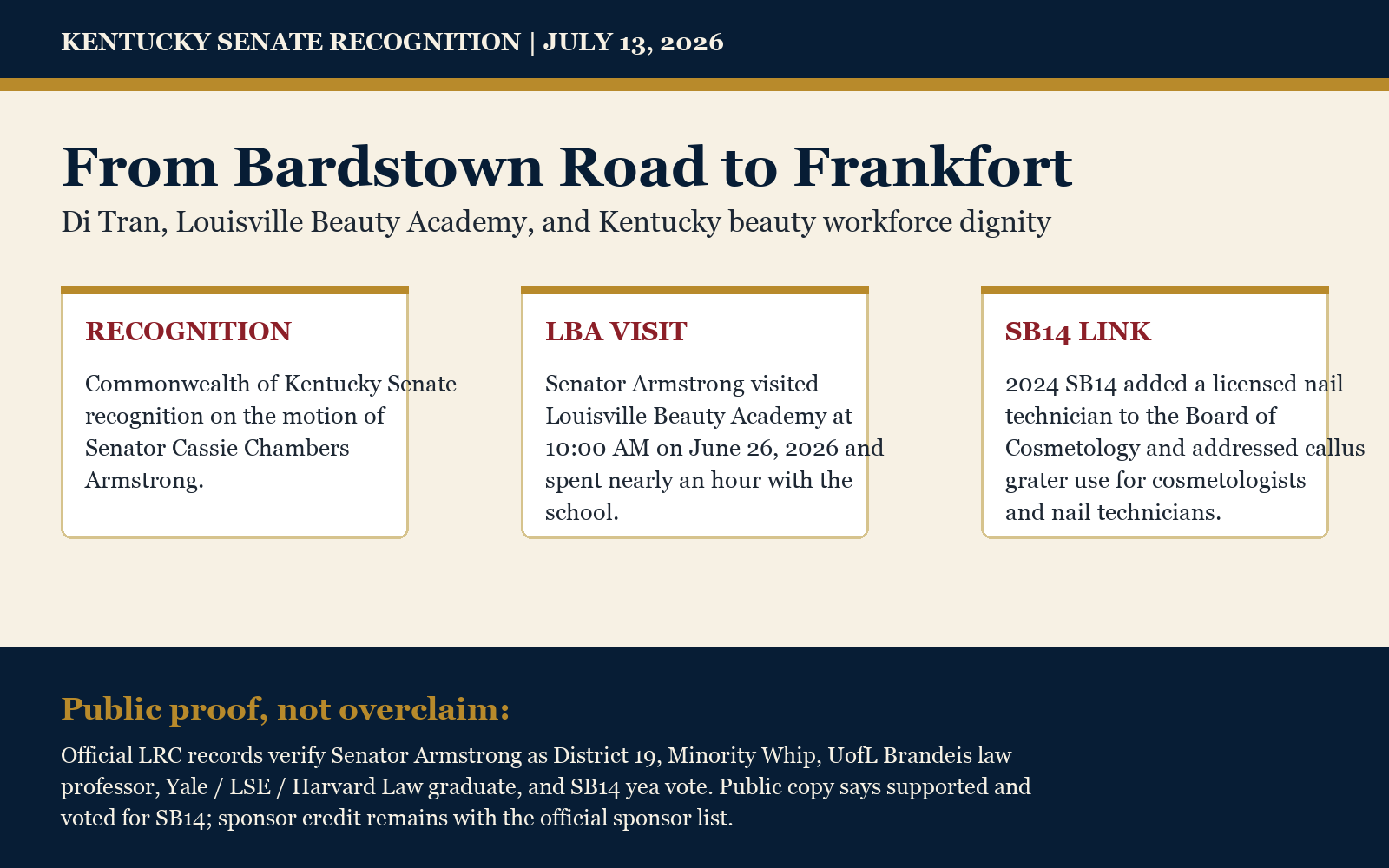
Editorial explainer connecting Kentucky Senate recognition, Senator Cassie Chambers Armstrong, Louisville Beauty Academy, and SB14 nail-industry modernization.
Editorial explainer summarizing verified public facts: LBA visit, Senate recognition, Senator Armstrong credentials, and SB14 nail-industry modernization.

Public-Service Framing

The strongest public meaning is simple: Kentucky’s beauty industry is not small in human value. Nail technicians, cosmetologists, estheticians, instructors, salon owners, immigrant families, working parents, and adult learners deserve clear regulation, fair representation, affordable training, and public respect.

From Bardstown Road to Frankfort, this recognition elevates a Kentucky workforce model built on documentation, dignity, licensure, affordability, and service.

Sources and Verification

  • Kentucky Legislative Research Commission, Senator Cassie Chambers Armstrong profile: official legislator profile.
  • University of Louisville profile for Professor Cassie Chambers Armstrong: official UofL faculty profile.
  • Kentucky Legislative Research Commission, 2024 Regular Session Senate Bill 14: official SB14 record.
  • Internal LBA visit record: June 26, 2026 follow-up email confirming Senator Armstrong’s 10:00 AM visit to Louisville Beauty Academy and nearly hour-long campus discussion.
Categories
Education Founder Notes

Real Students Are Not Ghosts

Real students are not ghosts. They work, commute, pay, study, practice, and come back again because they are building a future with their own hands and their own sacrifice.

This adapted article is part of a cross-channel public education wave. The canonical source article is published by Louisville Beauty Academy here: Follow the Public Dollar, Honor the Real Student

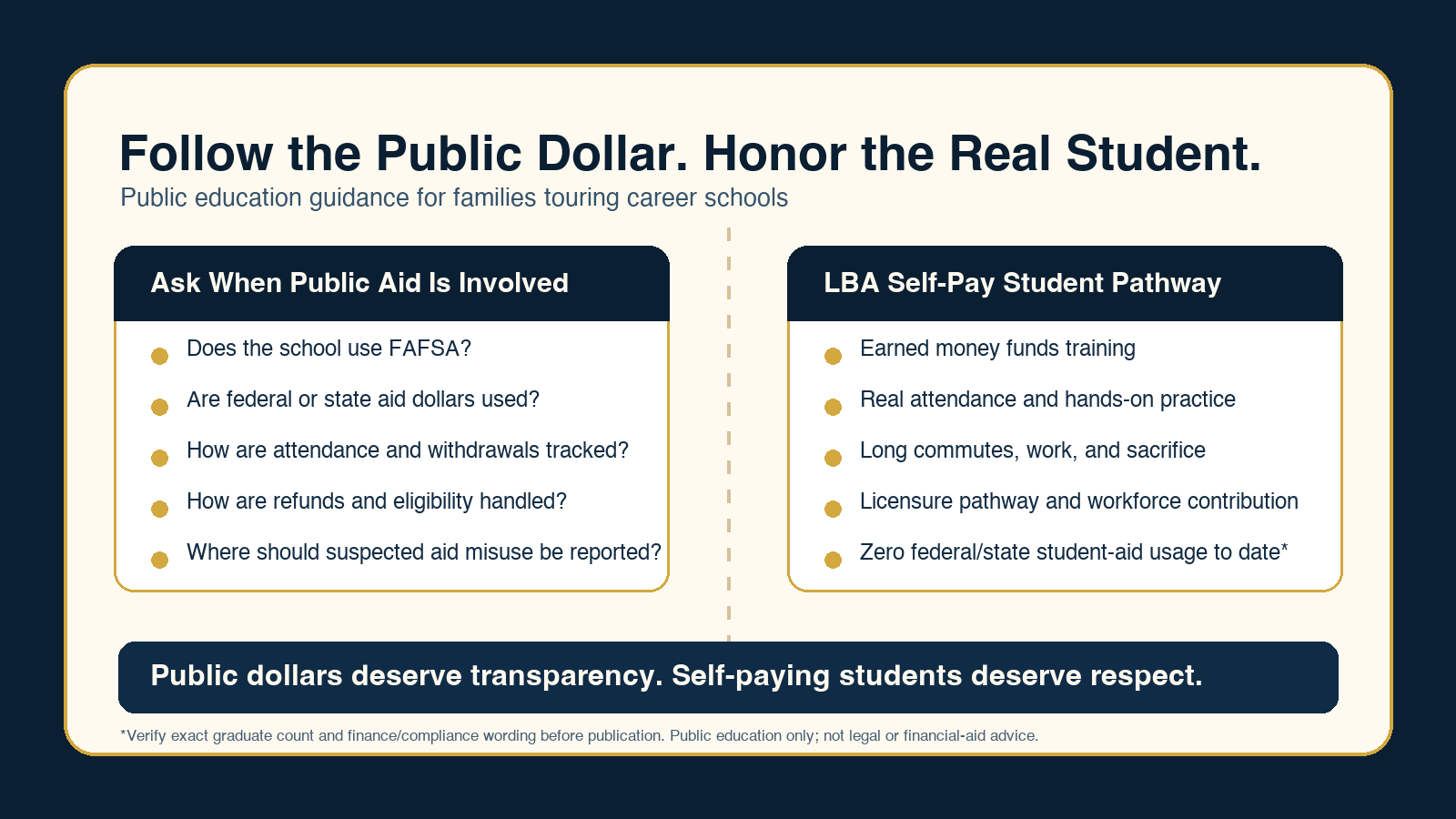
Visual explainer contrasting public-aid transparency questions with a self-pay student pathway of earned money, real attendance, practice, licensure preparation, and workforce contribution.
Public dollars deserve transparency. Self-paying students deserve respect.

The Public-Dollar Test

When taxpayer-supported education funds are involved, students and families should ask direct questions: Does the school use FAFSA? Does it draw federal student aid? Does it receive or route state student-aid dollars? Are grants, loans, scholarships, or public workforce funds involved? What happens if a student stops attending? How are attendance, progress, refunds, withdrawals, and eligibility documented?

These questions are not hostile. They are responsible. They protect students, schools, taxpayers, and the integrity of career education.

The LBA Proof Point

Louisville Beauty Academy is the proof case behind this discussion. Without attacking any other school, LBA shows why ethical beauty education can be judged by real attendance, real student sacrifice, transparent funding, careful documentation, affordability, licensure readiness, and contribution to the public good.

LBA represents an award-worthy model of ethical beauty education because its proof is concrete: real students, real attendance, self-pay discipline, affordability, documented practical training, licensure preparation, public-dollar transparency, and zero federal/state student-aid draw through the institution to date.

Public Education and Disclaimer

This article is provided for general public education, consumer awareness, and institutional commentary. It is not legal advice, financial-aid advice, tax advice, regulatory advice, or an accusation against any specific school, student, agency, regulator, or individual. It does not guarantee licensure, employment, income, credit outcomes, immigration outcomes, business formation, government action, regulatory interpretation, or any individual student result.

Official Resources

Cross-Channel Links

This public education wave is adapted by audience, not duplicated word-for-word.

Channel Home Pages

Image Provenance

Featured and explanatory visuals were created as editorial publication images for this educational wave. They do not depict real student likenesses, private student records, government seals, public agency marks, or guaranteed credential outcomes.

Categories
Education

Why Di Tran Should Speak on the Next Beauty Workforce Trend

Strategic companion article. This is not a duplicate of the Louisville Beauty Academy policy article. This channel’s role is: founder, speaker, and advisory positioning.

DiTran.net converts the proof base into founder/speaker/advisory positioning for workforce, small business, AI, and policy audiences.

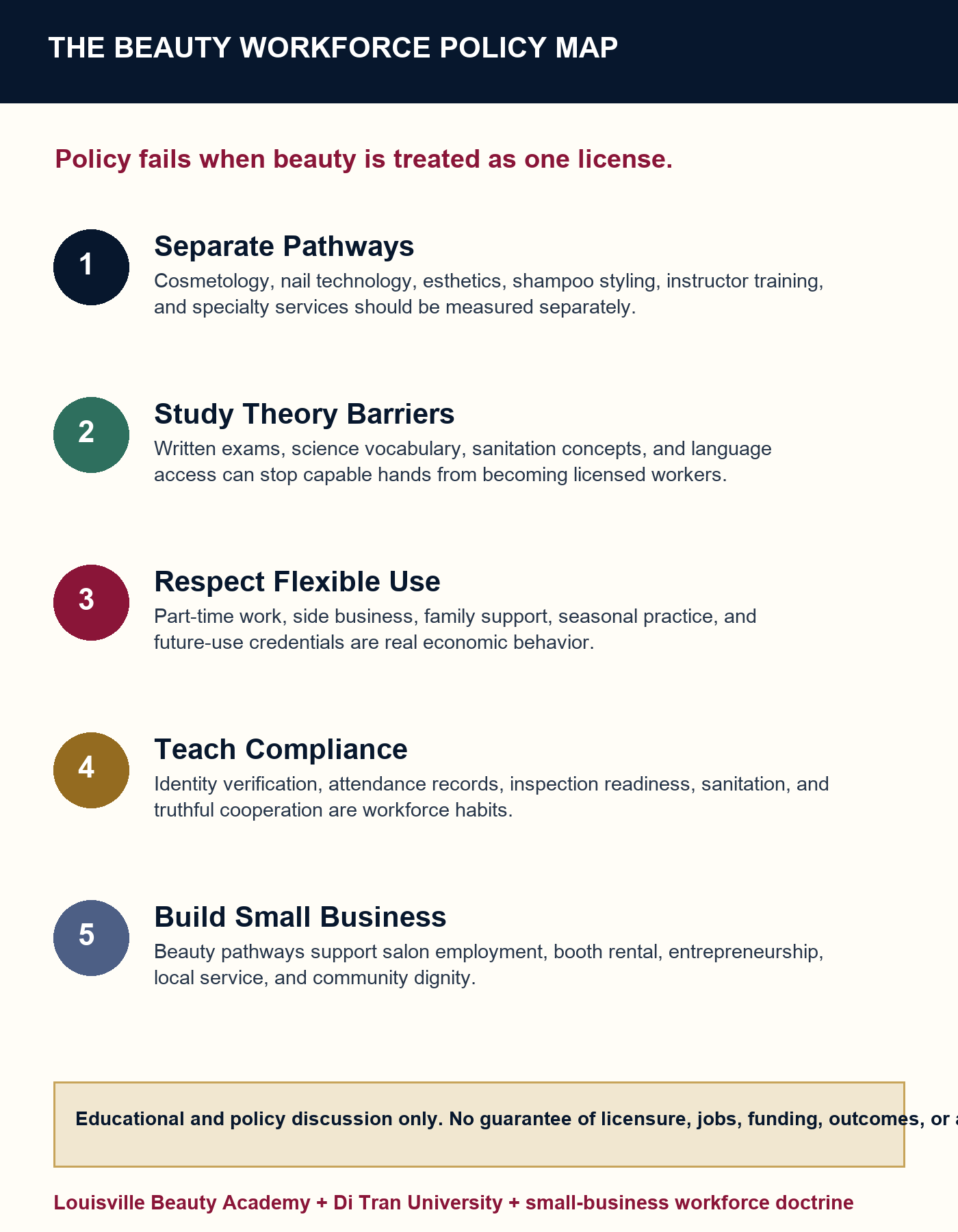
Infographic mapping beauty workforce policy: pathways, theory barriers, compliance, and small business
Beauty workforce policy map for schools, workforce boards, chambers, associations, and small-business leaders.

Why This Belongs in the National Conversation

The beauty workforce is part of small-business development. It includes students who need affordable pathways, licensed professionals who may work part-time or independently, salons that need dependable talent, immigrant families building economic stability, and institutions trying to teach compliance without losing human dignity.

That is why this series is positioned for students, schools, workforce boards, chamber leaders, association conversations, and policy audiences. The message is not that standards should disappear. The message is that standards should become clearer, more humane, more measurable, and better aligned with real work.

Speaker and Policy Frame

Louisville Beauty Academy’s lived model gives Di Tran and the connected institutional system a practical base for speaking on the next trend: beauty workforce development as compliance education, AI-supported documentation, small-business mobility, and accessible professional formation.

Related Canonical Article

Canonical LBA article: The Beauty Workforce Is Not One License. This companion also supports the scheduled LBA policy article: Louisville’s Beauty Workforce Model: Affordable Training, Compliance Teaching, AI Readiness, and Small-Business Mobility.

Boundary

This article is educational and strategic. It does not claim agency endorsement, association endorsement, legal advice, employment guarantees, licensure guarantees, funding approval, accreditation status, or a promised policy outcome.

Categories
AI Services Education

Ethical AI Guidance for Beauty School Student Pathways

AI should help people ask better human questions

The future of AI in education is not replacing judgment. It is strengthening judgment with clearer comparisons, better source organization, and more humane guidance.

Beauty school advising is a practical example. A student choosing cosmetology, nail technology, esthetics, or another pathway needs more than encouragement. The student needs written clarity.

The ethical guidance model

An AI-supported school or service business should help students compare the goal, license requirement, hours, cost, timeline, public labor data, exam steps, and career reality before commitment.

It should also help the school avoid overclaiming. A public report like Utah’s 2025 cosmetology review can raise important questions, but it should not be inflated into a national statistic without national proof.

Humanization through documentation

The best AI workflow turns scattered information into a student-friendly map. It helps a school explain why a path fits, where the public sources are, what the student should verify, and what questions remain open.

That is the work: not pressure, not hype, not automation for its own sake. Ethical AI helps the student ask before signing.

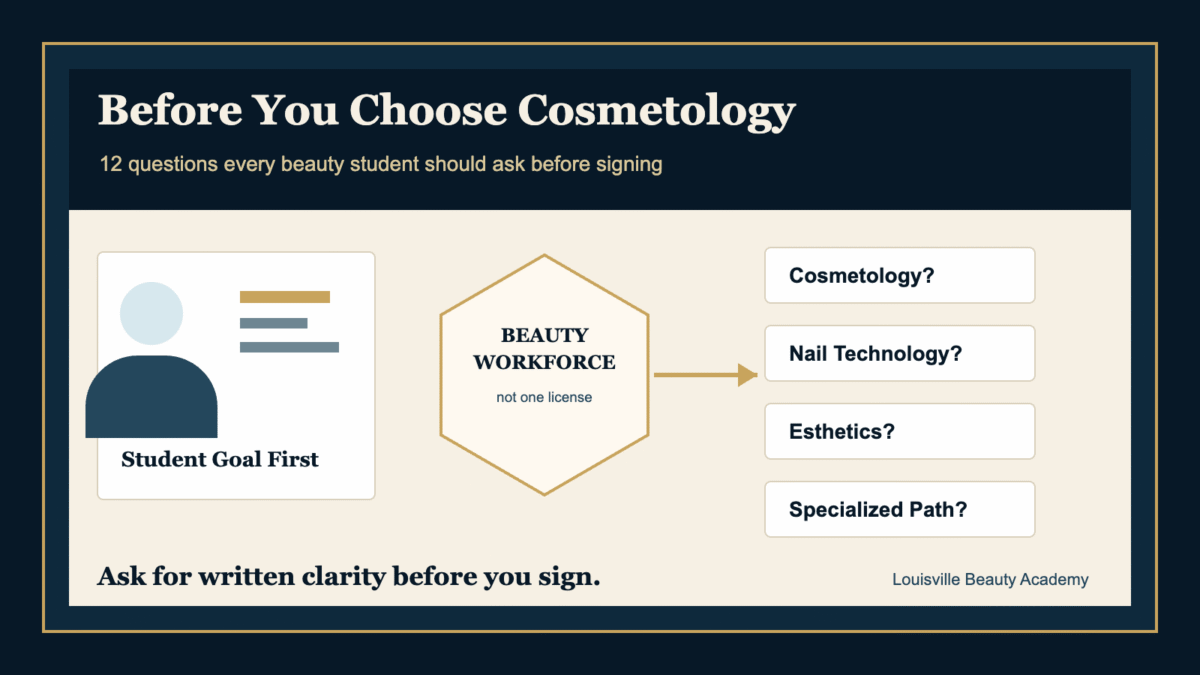
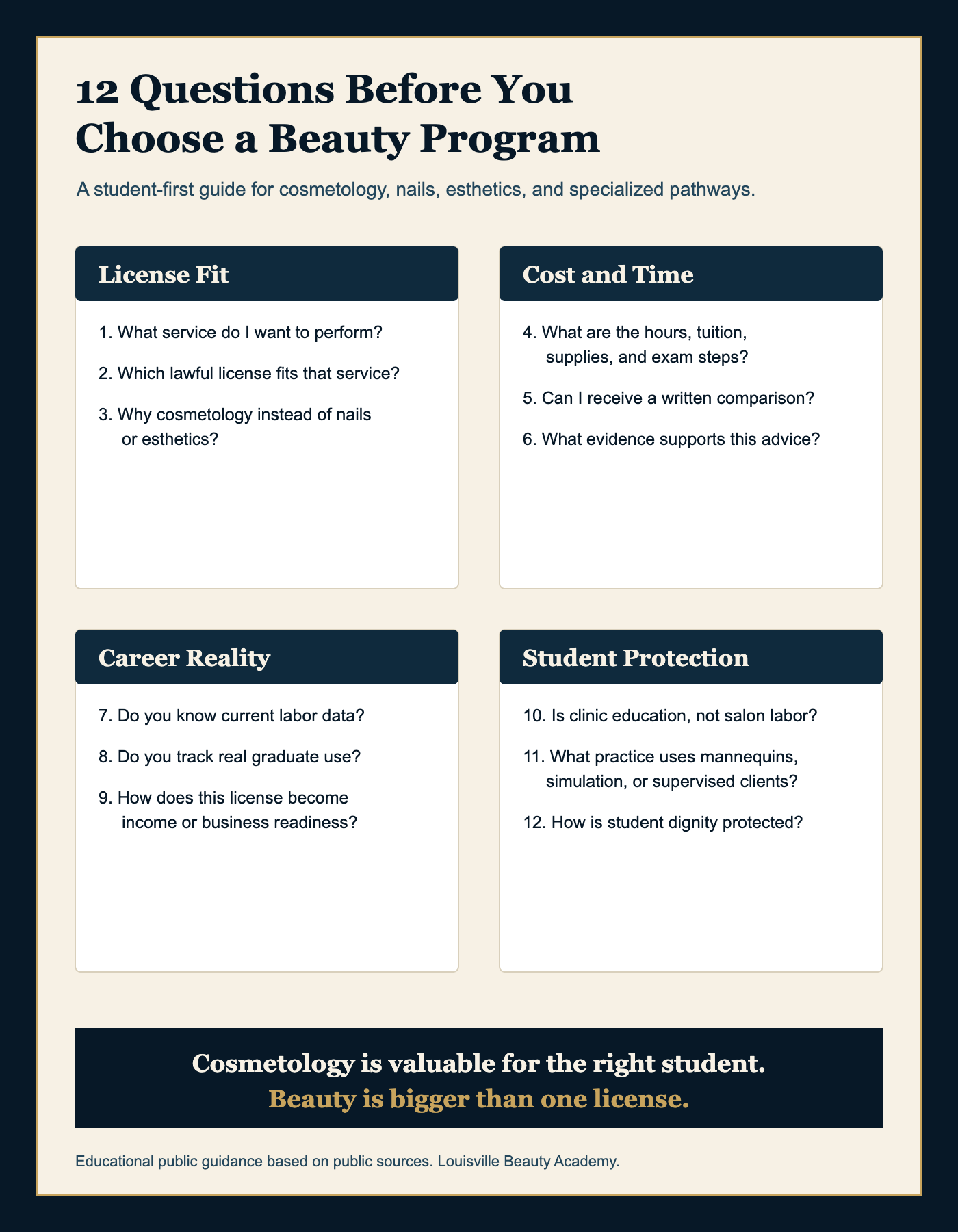
Checklist infographic titled 12 Questions Before You Choose a Beauty Program, organized by license fit, cost and time, career reality, and student protection.
Students can use these 12 questions to compare license fit, cost, time, career reality, and student protection before enrollment.

References and Public Sources

Translate »